Showing posts with label Indian History. Show all posts

Thursday, August 25, 2016

Confusing history with myth: Why ICHR should stick to history


Scholars have written copiously on the foolishness of discounting the role that myths play in understanding life and society, and the value of fiction, stories and tales passed on.

Written by Seema Chishti | New Delhi | Updated: August 18, 2016 8:38 pm

In legendary historian DD Kosambi’s excellent work on ancient India titled ‘Myth and Reality’ (1962), he writes about his essays, almost as if for 2016 India; “they are based upon the collation of field-work with literary evidence. Indian critics, whose patriotism outstrips their grasp of reality are sure to express annoyance or derision at the misplaced emphasis..”

Broadly defined as a story of the past, history has come to mean much more. In a society which is so diverse, it has often come to mean very different things to different people. History is a story that needs to be told cautiously sometimes but nevertheless must be told, taught and studied.

The bid of the Indian Council for Historical Research (ICHR) to announce that it is now going down the route of collecting detailed “folklore”, “custom” and “only documenting what is heard”, about the very distant past, appears fraught with monumental issues.

Scholars have written copiously on the foolishness of discounting the role that myths play in understanding life and society, and the value of fiction, stories and tales passed on. To be unmindful of prevalent legends would leave us the poorer in comprehending much harder material truths. But problems begin, when legends, myths and history are all sought to be confused.

The function of recording, teaching or studying History, is surely to learn lessons from the past, to be familiar with compatriots, to learn and unlearn about other lives, or at least that is the purpose we hope history serves for us, when taught in schools and beyond.

Historiography is serious and contested terrain but ground rules about what constitutes evidence and what hearsay suggests that it is very important that the difference be maintained.

There is no harm therefore in knowing about myths and legends, but to be able to tell clearly what a piece of pottery, jewellery, a grave or a monument or cooking utensils tell you about people long gone before us should be a priority in a vast and old civilisation like ours.

History is more important, when governments are involved in writing (and rewriting) textbooks. Textbooks being among the most useful ammunition to control young minds. The1980s phase in our neighbouring state of Pakistan survives uptil today in dangerously altered textbooks, or how history is studied in middle-schools. A recent project by two Pakistani scholars, Qasim Aslam and Ayyaz Ahmed, studies how differently Indian and Pakistani textbooks, learn about exactly the same facts. Not that India has got it all right, but the necessity of feeding myths to Pakistan was such a dominant idea there, that History was firmly pushed out of the frame.

Myths, being privileged over history writing, have been known to serve a useful political purpose. The myth of Aryan supremacy would have been a useful account to spin support for the Nazi view of the world in its time. When the ‘superiority’ of White-skinned plunderers in Africa had to be established, myths and legends, hearsay and anecdotes over years would have been a useful tool to establish why it was the way things should be. Which of us has not heard a story whispered at a monument which says the exact opposite of what we have known to be a recorded fact about the monument/area/people?

If only to avoid history from repeating itself, either as tragedy or a farce, it may be well worth the while of institutions like ICHR, tasked with serious historical research to do exactly that. Myths have a place, but for India to have a functional present and future, they must not be confused with history.

Wednesday, September 23, 2015

Researchers, activists bat for Mhatoba shrine status quo


Ananya Dutta,TNN | Sep 21, 2015, 03.00 AM IST

PUNE: The shrine dedicated to Mhatoba on top of Vetal Tekdi is an important cultural and historical site and should be maintained as it is, instead of obscuring it with a modern structure, feel experts and environmentalists.

"The Mhatoba shrine is important from an archaeological point of view as well as in terms of the folk and cult geography of Pune. Building a modern-style temple on the site would erase the actual ritual association that pastoral communities had with the shrine," said Indologist and researcher Saili K Palande Datar.

As far back as 1962, historian and polymath D D Kosambi had commented on the importance of the site in mapping the cult of Mhatoba. In his book 'Myth and Reality — Studies in the Formation of Indian Culture', Kosambi terms this shrine on the hilltop as "the original locus" of the Mhatoba of Kothrud village. According to him, it came here along with "herdsmen" from Wakad, where there is a temple to Mhatoba and his consort — a structure older than 1678AD.

Kosambi also found prehistoric artefacts in the vicinity of the shrine, including what may be megaliths (large stones) from an ancient burial site.

"I have been visiting the site from the 1960s. It used to be as Kosambi has described it, 'a red-daubed boulder' minimally covered with a tin shed. It was revered by Dhangar and Wadar communities, who would offer a sacrifice to the deity when passing through Pune," said environmental activist Vijay Paranjpye.

Palande Datar said the communities that have historical associations with the shrine, such as the Dhangars, don't even pass through the area anymore. "Altering the structure would be an appropriation of their cultural symbols and amount to an erasure of history. Introducing something new will damage the cultural significance of the site," she said.

She said that several hills in and around Pune are associated with similar folk and tribal deities, many of them closely connected with the conservation of biodiversity. The Waghjai and Taljai goddesses on Taljai Tekdi for instance were associated with their own sacred groves on the hill.

"Both these deities are Mother Goddesses worshipped by forest-dwelling communities. Over the years, the land-use pattern of the hill has changed, but they were originally protectors of its environment," she said.

A key aspect of retaining the shrines in their original form is that many of them were not meant to be enclosed by any artificial structure. Kosambi had noted that the "primitive origin and nature" of the cults was shown by the injunction that the stone must be open to the sky. He saw it as a sign that the cults date back to a period "before houses were in fashion, and when the 'village' was on the move".

"The shrine on top of Vetal Tekdi, along with its natural precincts, is a very important cultural heritage site. The shrine as I have known it all these years was always open to the skies. It should be maintained as it is, without disturbing its natural precincts," Paranjpye said.

Thursday, February 19, 2015

Some Theoretical comments on DD Kosambi's The Culture and Civilization of Ancient India

A paper by R. Sundara Rajan.

Indian Philosophical Quarterly : Volume 3. January 1976

"Conflict is the main spring of Marxian social dynamics, whereas in Kosambi, there is no such clear identification of a dynamic factor; he merely speaks of successive changes in the means and relations of production. But if we wish to identify the dynamic factor in Kosambi's model of change, we have to look to another context and surprisingly enough, it turns out to be population growth"
Download: https://app.box.com/s/15db6oy3m91moo5wjw7c9gly7m1xc5j3

Alternate download from source: Indian Philosophical Quarterly, University of Pune


Wednesday, January 30, 2013

Remembering D. D. Kosambi


Remembering D. D. Kosambi


Progressive circles in India have been late in remembering D. D. Kosambi in 2007, the centennial year. Of course Pune, where Kosambi lived and died, led the way to centenary celebrations. A committee was formed with R. P. Nene and Meera Kosambi, daughter of D. D. Kosambi, to pay homage to the savant extraordinary in a befitting manner. A number of public lectures were organized on and from 31 July 2007, with Romila Thapar, Irfan Habib, Prabhat Patnaik, and others as speakers. The Birth Centenary Committee has also been successful in persuading the Government of India to issue a postal stamp and instituting a Chair in the name of Kosambi in the University of Pune. The Human Resources Development ministry has sanctioned a grant of Rs. one crore (ten million) for this post. One, however, cannot be sure whether the right man will be appointed to continue the works of Kosambi along his lines.

DD Kosambi
Memorial meetings have been held in Aurangabad, Kolkata, Goa, Manipal, and Mumbai and maybe in other places in India. A Kosambi Festival was held in Goa from 4 to 7 February 2008 to celebrate “the life and work of an extraordinarily erudite son of a legendary figure in Goan intellectual history, the Abhimanyu of an Arjun, as someone has said about Damodar Kosambi and his father Dharmanand” (Reported by Sandhya Palekar in Indian Skeptic, 21: 1, 15. 05. 2008, p. 18). Dr.Vivek Monteiro, a Harvard doctorate, who abandoned the Tata Institute of Fundamental Research to teach mathematics and science to the children of slum-dwellers of Mumbai,  and finally became a trade unionist, gave a talk on “Science as the cognition of necessity”, the definition of science proposed by Kosambi.

Such attempts, however laudable, are not sufficient to make the new generation aware of what a versatile genius Kosambi was. Of course, it is not possible for a single person even to describe in broad terms, not to speak of evaluate, the contributions made by Kosambi in such diverse fields as anthropology, archaeology, classical genetics, Indian history, mathematics, numismatics, statistics, and Sanskrit text criticism. He was equally thoroughgoing in all the disciplines he had enriched. The bibliography of his works is bound to fill anyone with awe. A man like him is rare in all ages, more particularly in our times when ‘superspecialization’ is the key to both fame and success. In what follows I shall try to give an inkling of the man Kosambi, not the prodigious scholar he was.

D. D. Kosambi and the Sociology of Literature: A Critique


D. D. Kosambi and the Sociology of Literature: A Critique


Ramkrishna Bhattacharya

D. D. Kosambi (1907-66) was trained as a mathematician and used to teach and research in mathematics till 1941. Then he wrote an ‘exasperating essay’ on the Sanskrit epigrams attributed to Bhartrihari. This essay, Kosambi says, ‘caused every godfearing Sanskritist to shudder’ and consequently ‘I fell into Indology, as it were, through the roof’.1

The essay ‘upset’, among others, V. S. Sukthankar, the celebrated general editor of the critical edition of the Mahabharata.2 He was however, not able to give a definite contradiction in any essential of Kosambi’s basic contention. There were also a few points in the essay that caused others to be puzzled. Some readers, for example, felt that there was ‘a seeming inconsistency’ in a passing reference to Shakespeare’s dramas which ‘were assigned a class basis of the rising proto-bourgeoisie’.3

Kosambi took up the matter in a short essay written in 1958. Since this piece has not been included in any collection of writings by Kosambi, it is necessary to quote long extracts from it and then critique his approach. Kosambi had also touched on the same issue in a section of his Introduction to an anthology of Sanskrit poetry which was edited for the first time by him and V.V. Gokhale.4 It will be my endeavour to show how Kosambi makes use of Marx’s formulation of the relationship between the base and the superstructure and how Kosambi demonstrates its validity in two disparate cases, namely, ancient Sanskrit literature and English literature of the sixteenth and early seventeenth centuries. Although Kosambi does not explicitly refer to Marx in this connection there can be little doubt that he drew his conclusions from Marx.

Untouchability, Gita and the Pursuit of Truth

Download the articleUntouchability, Gita, and the Pursuit of Truth

Remembering Vivekanand Jha
by Vishwa Mohan Jha

It might come as a surprise to the uninitiated that untouchability remains among the darkest aspects of India’s social history – despite Bhimrao Ambedkar, Marxist and “post-Marxist” histories, a wealth of contemporary caste studies, and the rise of dalit politics. It is to the labours of Vivekanand Jha, who passed away on 30 November 2012, that so much of our present understanding of the history of untouchability in ancient India is indebted to.

Historians had generally been evasive about the issue; or else we had apologias. Thus in the brief chapter on untouchability in the second volume of P V Kane’s masterly History of Dharma śāstra, all that he discussed was that inequities such as untouchability were not unique to India but were a fairly widespread phenomena; that it was not to be found in our glorious Vedic period; and how in numerous ways it has been  is represented, its evils exaggerated. While we need to recognise, for example, that concern with hygiene contributed to the making of untouchability, we can equally be certain (Kane contended) that it was imposed with no hard feelings towards the untouchables!1 Ambedkar sought to fill the void and provide a corrective. In his Untouchables: Who Were They? and Why They Became Untouchables? (1948), he historicised the issue in important ways, as by drawing the crucial distinction between impurity and untouchability, and located the origins of the latter in the beef -eating of the downtrodden. 

Historian’s Labour 

DD Kosambi Commemoration Volume (1974)

We now have this veritable goldmine of essays in honour of DD Kosambi, brought out in 1974. Thanks, once again to Arvind Gupta.

Download the pdf

Saturday, October 20, 2012

Marxism and Classical Sanskrit Literature: D.D. Kosambi’s Approach and Assessment


Download Marxism and Classical Sanskrit Literature: DD Kosambi's Approach and Assessment

by Ramakrishna Bhattacharya

"In this essay I examine D. D. Kosambi’s approach and assessment of classical Sanskrit literature from the Marxist point of view. In the first part, I discuss S. N. Dasgupta’s critique of the Marxist approach to art and literature, arguing that Dasgupta had an idealist (and idealized) view of Indian society that does not match historical reality. I then contrast Dasgupta’s views with those of Kosambi. The latter asserted that there was no qualitative change in the means of production and hence in the relations of production in India before the imposition of British rule. In his view, classical Sanskrit literature too reflects this ground reality. In the second part, I discuss how Kosambi’s Marxist approach to art and literature was both aesthetic and historical. Through presenting Kosambi’s appreciation of classical Sanskrit literature, I show that Daniel H. H. Ingalls misapprehended Kosambi’s views and that his criticism of Kosambi was misdirected accordingly."


Thursday, April 19, 2012

Our past is being moth-eaten


India's archives and libraries are in a state of ruin. We would lose our history and heritage if the government does not act to save them.

How do you destroy Indian history? In Delhi, letters written by Mahatma Gandhi, Dadabhai Naoroji, and Babasaheb Ambedkar are left to rot away in rooms lacking proper temperature control. In Lucknow, secretariat holdings are dumped and burned. And in Chennai, archival records are literally washed away by the monsoons.

Among both foreign and Indian scholars, it is an open secret that most Indian archives and libraries are in a deplorable state. Over the past 15 months, I have visited many institutions across the country in connection with my dissertation research on Naoroji. What I have seen has disturbed me. Archival experiences recounted by my academic colleagues have horrified me. Unless the government takes quick and decisive action, India is at risk of letting much of its heritage literally crumble into dust. Sources of Indian history are at grave risk of being lost forever.

Poor preservation

India is a country that is justifiably proud of its illustrious past. But this pride does not always translate into proper custodianship and preservation. Most Indians would cringe at how sources of Indian history are treated in government institutions. In spite of the plethora of capable administrators and skilled archivists in this country, many institutions do not follow clear, up-to-date, and verifiable standards for document preservation.

State-level facilities, where the majority of public archives are housed, are in the greatest need of help. Many institutions are housed in old buildings that may actually facilitate rapid damage to collections. The Maharashtra State Archives in Mumbai, for example, is located in an open-air structure built in 1888. As a result, pigeons regularly fly into the premises and leave their droppings on centuries-old colonial factory records and priceless newspaper collections. Occasionally, as an American colleague recently recalled, a pigeon will collide into a fan, plummet to the floor, and writhe around in a pool of blood until a peon is charged with cleaning up the mess.

The situation is also quite grim in New Delhi. At the National Archives of India, I consult Naoroji's papers in the Private Archives room, which has broken windows and no proper climate control. It is no surprise, therefore, that thousands of Naoroji's letters have been destroyed over the past few decades and that thousands more are now too damaged to be read: while Naoroji bequeathed over 60,000 items upon his death in 1917, less than 30,000 survive today. The papers of Naoroji's colleagues, such as Romesh Chunder Dutt, are in a similarly shameful state. How would the Grand Old Man react to this disappearance of so much nationalist heritage?

Poor upkeep has also damaged more recent records. Some of Dr. Ambedkar's correspondence has decayed into piles of scraps. This should not happen in a country where his legacy and memory are subjects of such great contestation and debate.

Within the international academic community, Indian archival experiences are traded like war stories. In the 1990s, an eminent British political scientist found documents and files from the Uttar Pradesh Secretariat's library dumped and burned outside. The Secretariat, the political scientist noted, contained valuable revenue settlement and provincial police reports that are probably not available anywhere else. In the fall of 2005, an M.Phil. candidate from Delhi University saw staff at the Tamil Nadu State Archives in Chennai hanging a clothesline on the archives' verandah. Why? It was being used to dry out historical papers soaked during a monsoonal deluge. And in 2008, staff at the West Bengal State Archives in Kolkata chose to go on a month-long strike after an Ivy League professor made a routine request for a document.

These three instances hint at glaring problems in the ways that Indian archives and libraries are managed. In order for there to be any hope for the long-term survival of India's sources of history, the Union and State governments need to urgently bring about real and lasting changes.

The most necessary change is also the simplest. These institutions need to be housed in proper facilities. In 21st century India, it is absolutely absurd that records and collections continue to be housed in Raj-era structures that have hardly been modernised since they were built. This is tantamount to condemning documents to 19th century preservation methods. In order for old documents to be preserved, they need to be kept in sealed, temperature-controlled environments where the elements, humidity, insects, and animals are kept at bay. The new director of the Maharashtra State Archives is pushing the State government to build such a structure for her institution. She needs support.

At the same time, new buildings must conform to the highest standards. The National Archives' annexe was inaugurated in 1991 but its construction is of such substandard quality that its roof is leaking, its window panes have fallen off, and its storage facilities are a veritable magnet for dirt and dust. Our history deserves better than this.

Secondly, these institutions need highly qualified directors and staff. There are now some encouraging developments. The National Archives, which was left rudderless for several years, now finally has a director general. He has brought about visible and commendable change in his two years on the job, helping modernise the facility and improve standards of preservation and recordkeeping. The Nehru Memorial Museum and Library, the leading storehouse of non-official documents, is busy reviewing existing practices and upgrading skills and techniques. Here too, a new director is working with other experts to effect changes.

Dearth of staff

But qualified directors, alone, cannot institute real change. There is a glaring dearth of trained archivists and librarians in institutions across the country. In spite of the real talent that India yearly produces in these fields, most archives, museums, and libraries have a shockingly high number of empty posts. The reasons are not difficult to discern. It can take anywhere from two to three years for the Union Public Service Commission to clear an applicant's file for a vacancy. During that period of time, most candidates will have found another job; any remaining candidates will be deterred by low pay scales and the promise of a poor work environment. As one archival official told me, the Indian government looks upon its archivists and librarians as “dignified clerks.” It is a miracle that, in spite of everything, many central and state institutions retain a core of dedicated, professional staff.

The critical shortage of trained staff has had one very destructive consequence. Methods and technologies of preservation have greatly lagged behind what is practised elsewhere in the world. I have been dismayed to see archivists across India use technologies that were abandoned in the West decades ago. For example, the preservation technique of lamination — whereby brittle documents are pasted in between thin sheets of paper — is still widely and indiscriminately used. This technique, as archivists in the British Library inform me, is no longer commonly practised there due to adverse long-term consequences.

I have seen these consequences first hand: Gandhi's earliest surviving letter to Naoroji is no longer legible due to lamination. Without more qualified preservationists, institutions in India are unable to keep up with international best practices or even review their own preservation policies, assimilating tried-and-tested techniques with new methods.

Autonomy
In order to facilitate the hiring and retention of India's best talent, and in order to put an end to decades of neglect and destruction, certain institutions, such as the National Archives, should be granted a degree of autonomy. The National Archives desperately needs more qualified staff in order to assist in projects for preservation, catalouging, and upkeep. At present, the director has limited powers even to repair those broken windows that daily let in dust, mosquitoes, and hornets into the room where I work: all repairs must go though the Central Public Works Department, adding a completely unnecessary layer of bureaucracy.

The Ministry of Culture, which oversees so many of India's cultural treasures, must provide the right conditions for allowing India's best historians, librarians, and archivists to give Indian heritage the dedication and care it deserves. The Nehru Library, which has a degree of autonomy, provides an interesting model of an institution that has fared better than most.

Indian libraries and archives have enormous potential. They are home to some of the world's greatest and most important collections of historical documents. With qualified directors, better staff, and proper facilities, these institutions can take their rightful places as internationally-recognised centres of scholarship. They can help restore India's pride of place as a global hub of learning and culture. Will the government help give India's history the future it deserves?

(Dinyar Patel is Ph.D. candidate, Department of History, Harvard University. dinyar.patel@gmail.com)


Thursday, April 5, 2012

Harappan relics excavated in Karnal?

By: Manish Sirhindi Source:
The Tribune
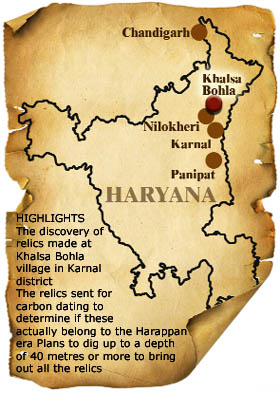
 A map shows the location of Khalsa Bohla village in Karnal district where relics have been excavated. Graphic: Rajbir Singh Nilokheri (Karnal), April 5 Archaeological experts from Banaras Hindu University (BHU) and Cambridge University, London, have dug out relics believed to be associated with the Harappan civilization. The discovery was made at Khalsa Bohla village in the district from a mound spread over 400 metres.

The excavation teams are being led by Arun Pandey of Banaras Hindu World School and historian Patrick from Cambridge University of London. Arun Pandey said the excavation was in the initial stages and they had dug up only four metres of land. He said the team had already found relics, including utensils, pottery and bones, which are believed to have been used by people belonging to the Harappan era. Pandey said the excavated relics had been sent for carbon dating to ascertain their exact age to determine if these actually belonged to the Harappan era.

The size and shape of utensils made of mud suggested that these were of the Harappan times. He said the team planned to dig to a depth of 40 metres or more to bring out all the relics. He claimed the excavation was being carried out carefully so that no damage was caused to any historical object.

Gumeet Singh, sarpanch of the village, said the excavation assumed significance as the epic war of Mahabharata was fought at this village and the excavated relics could date back to that period.

Thursday, December 29, 2011

Understanding ancient Indian mathematics

This topic lies at the intersection of DD Kosambi's twin interests in ancient Indian history and mathematics.

Source:http://www.thehindu.com/sci-tech/science/article2747006.ece

It is high time we studied our mathematical heritage with diligence and objectivity

By S.G. DANI

A portion of a dedication tablet in a rock-cut Vishnu temple in Gwalior built in 876 AD. The number 270 seen in the inscription features the oldest extant zero in India.

Caption: A portion of a dedication tablet in a rock-cut Vishnu temple in Gwalior built in 876 AD. The number 270 seen in the inscription features the oldest extant zero in India.

Quite often I find that conversations, with people from various walks of life, on ancient Indian mathematics slide to “Vedic mathematics” of the “16 sutras” fame, which is supposed to endow one with magical powers of calculation. Actually, the “16 sutras” were introduced by Bharati Krishna Tirthaji, who was the Sankaracharya of Puri from 1925 until he passed away in 1960, associating with them procedures for certain arithmetical or algebraic computations. Thus, this so-called “Vedic mathematics (VM)” is essentially a 20th century phenomenon.

Neither the “sutras” nor the procedures that they are supposed to yield, or correspond to, have anything to do with either the Vedas, or even with any post-Vedic mathematical tradition of yore in India. The image that it may conjure up of ancient rishis engaged in such arithmetical exercises as are taught to the children in the name of VM, and representing the solutions through word-strings of a few words in modern styled Sanskrit, with hardly any sentence structure or grammar, is just too far from the realm of the plausible. It would have amounted to a joke, but for the aura it has acquired on account of various factors, including the general ignorance about the knowledge in ancient times. It is a pity that a long tradition of over 3,000 years of learning and pursuit of mathematical ideas has come to be perceived by a large section of the populace through the prism of something so mundane and so lacking in substance from a mathematical point of view, apart from not being genuine.

Tall claims

The colossal neglect involved is not for want of pride about the achievements of our ancients; on the contrary, there is a lot of writing on the topic, popular as well as technical, that is full of unsubstantiated claims conveying an almost supreme knowledge our forefathers are supposed to have possessed. But there is very little understanding or appreciation, on an intellectual plane, of the specics of their knowledge or achievements in real terms.

In the colonial era this variety of discourse emerged as an antithesis to the bias that was manifest in the works of some Western scholars. Due to the urgency to respond to the adverse propaganda on the one hand and the lack of resources in addressing the issues at a more profound level on the other, recourse was often taken to short-cuts, which involved more assertiveness than substance. There were indeed some Indian scholars, like Sudhakar Dvivedi, who adhered to a more intellectual approach, but they were a minority. Unfortunately, the old discourse has continued long after the colonial context is well past, and long after the world community has begun to view the Indian achievements with considerable objective curiosity and interest. It is high time that we switch to a mode betting a sovereign and intellectually self-reliant society, focussing on an objective study and critical assessment, without the reference frame of “what they say” and how “we must assert ourselves.”

Ancient India has indeed contributed a great deal to the world's mathematical heritage. The country also witnessed steady mathematical developments over most part of the last 3,000 years, throwing up many interesting mathematical ideas well ahead of their appearance elsewhere in the world, though at times they lagged behind, especially in the recent centuries. Here are some episodes from the fascinating story that forms a rich fabric of the sustained intellectual endeavour.

Vedic knowledge

The mathematical tradition in India goes back at least to the Vedas. For compositions with a broad scope covering all aspects of life, spiritual as well as secular, the Vedas show a great fascination for large numbers. As the transmission of the knowledge was oral, the numbers were not written, but expressed as combinations of powers of 10. It would be reasonable to believe that when the decimal place value system for written numbers came into being it owed a great deal to the way numbers were discussed in the older compositions.

The decimal place value system of writing numbers, together with the use of ‘0,' is known to have blossomed in India in the early centuries AD, and spread to the West through the intermediacy of the Persians and the Arabs. There were actually precursors to the system, and various components of it are found in other ancient cultures such as the Babylonian, Chinese, and Mayan. From the decimal representation of the natural numbers, the system was to evolve further into the form that is now commonplace and crucial in various walks of life, with decimal fractions becoming part of the number system in 16th century Europe, though this again has some intermediate history involving the Arabs. The evolution of the number system represents a major phase in the development of mathematical ideas, and arguably contributed greatly to the overall advance of science and technology. The cumulative history of the number system holds a lesson that progress of ideas is an inclusive phenomenon, and while contributing to the process should be a matter of joy and pride to those with allegiance to the respective contributors, the role of others also ought to be appreciated.

It is well-known that Geometry was pursued in India in the context of construction of vedis for the yajnas of the Vedic period. The Sulvasutrascontain elaborate descriptions of construction of vedis and enunciate various geometric principles. These were composed in the rst millennium BC, the earliest Baudhayana Sulvasutra dating back to about 800 BC. Sulvasutra geometry did not go very far in comparison to the Euclidean geometry developed by the Greeks, who appeared on the scene a little later, in the seventh century BC. It was, however, an important stage of development in India too. The Sulvasutra geometers were aware, among other things, of what is now called the Pythagoras theorem, over 200 years before Pythagoras (all the four major Sulvasutras contain an explicit statement of the theorem), addressed (within the framework of their geometry) issues such as nding a circle with the same area as a square and vice versa, and worked out a very good approximation to the square root of two, in the course of their studies.

Though it is generally not recognised, the Sulvasutra geometry was itself evolving. This is seen, in particular, from the differences in the contents of the four major extant Sulvasutras. Certain revisions are especially striking. For instance, in the early Sulvasutra period the ratio of the circumference to the diameter was, as in other ancient cultures, thought to be three, as seen in a sutra of Baudhayana, but in the Manava Sulvasutra, a new value was proposed, as three-and-one-fth. Interestingly, the sutra describing it ends with an exultation “not a hair-breadth remains,” and though we see that it is still substantially off the mark, it is a gratifying instance of an advance made. In the Manava Sulvasutra one also nds an improvement over the method described by Baudhayana for nding the circle with the same area as that of a given square.

The Jain tradition has also been very important in the development of mathematics in the country. Unlike for the Vedic people, for Jain scholars the motivation for mathematics came not from ritual practices, which indeed were anathema to them, but from the contemplation of the cosmos. Jains had an elaborate cosmography in which mathematics played an integral role, and even largely philosophical Jain works are seen to incorporate mathematical discussions. Notable among the topics in the early Jain works, from about the fifth century BC to the second century AD, one may mention geometry of the circle, arithmetic of numbers with large powers of 10, permutations and combinations, and categorisations of innities (whose plurality had been recognised).

As in the Sulvasutra tradition, the Jains also recognised, around the middle of the rst millennium BC, that the ratio of the circumference of the circle to its diameter is not three. In “Suryaprajnapti,” a Jain text believed to be from the fourth century BC, after recalling the “traditional” value three for it, the author discards that in favour the square root of 10. This value for the ratio, which is reasonably close to the actual value, was prevalent in India over a long period and is often referred as the Jain value. It continued to be used long after Aryabhata introduced the well-known value 3.1416 for the ratio. The Jain texts also contain rather unique formulae for lengths of circular arcs in terms of the length of the corresponding chord and the bow (height) over the chord, and also for the area of regions subtended by circular arcs together with their chords. The means for the accurate determination of these quantities became available only after the advent of Calculus. How the ancient Jain scholars arrived at these formulae, which are close approximations, remains to be understood.

Jain tradition

After a lull of a few centuries in the early part of the rst millennium, pronounced mathematical activity is seen again in the Jain tradition from the 8th century until the middle of the 14th century. Ganitasarasangraha of Mahavira, written in 850, is one of the well-known and inuential works. Virasena (8th century), Sridhara (between 850 and 950), Nemicandra (around 980 CE), Thakkura Pheru (14th century) are some more names that may be mentioned. By the 13th and 14th centuries, Islamic architecture had taken root in India and inGanitasarakaumudi of Thakkura Pheru, who served as treasurer in the court of the Khilji Sultans in Delhi, one sees a combination of the native Jain tradition with Indo-Persian literature, including work on the calculation of areas and volumes involved in the construction of domes, arches, and tents used for residential purposes.

Mathematical astronomy or the Siddhanta tradition has been the dominant and enduring mathematical tradition in India. It ourished almost continuously for over seven centuries, starting with Aryabhata (476-550) who is regarded as the founder of scientic astronomy in India, and extending to Bhaskara II (1114-1185) and beyond. The essential continuity of the tradition can be seen from the long list of prominent names that follow Aryabhata, spread over centuries: Varahamihira in the sixth century, Bhaskara I and Brahmagupta in the seventh century, Govindaswami and Sankaranarayana in the ninth century, Aryabhata II and Vijayanandi in the 10th century, Sripati in the 11th century, Brahmadeva and Bhaskara II in the 12th century, and Narayana Pandit and Ganesa from the 14th and 16th centuries respectively.

Aryabhatiya, written in 499, is basic to the tradition, and even to the later works of the Kerala school of Madhava (more on that later). It consists of 121 verses divided into four chapters — Gitikapada, Ganitapada, Kalakriyapada and Golapada. The rst, which sets out the cosmology, contains also a verse describing a table of 24 sine differences at intervals of 225 minutes of arc. The second chapter, as the name suggests, is devoted to mathematics per se, and includes in particular procedures to nd square roots and cube roots, an approximate expression for ‘pi' (amounting to 3.1416 and specied to be approximate), formulae for areas and volumes of various geometric gures, and shadows, formulae for sums of consecutive integers, sums of squares, sums of cubes and computation of interest. The other two chapters are concerned with astronomy, dealing with distances and relative motions of planets, eclipses and so on.

Influential work

Brahmagupta's Brahmasphutasiddhanta is a voluminous work, especially for its time, on Siddhanta astronomy, in which there are two chapters, Chapter 12 and Chapter 18, devoted to general mathematics. Incidentally, Chapter 11 is a critique on earlier works including Aryabhatiya; as in other healthy scientific communities this tradition also had many, and often bitter, controversies. Chapter 12 is well-known for its systematic treatment of arithmetic operations, including with negative numbers; the notion of negative numbers had eluded Europe until the middle of the second millennium. The chapter also contains geometry, including in particular his famous formula for the area of a quadrilateral (stated without the condition of cyclicity of the quadrilateral that is needed for its validity — a point criticised by later mathematicians in the tradition). Chapter 18 is devoted to the kuttaka and other methods, including for solving second-degree indeterminate equations. An identity described in the work features also in some current studies where it is referred as the Brahmagupta identity. Apart from this, Chapter 21 has verses dealing with trigonometry. Brahmasphutasiddhanta considerably influenced mathematics in the Arab world, and in turn the later developments in Europe. Bhaskara II is the author of the famous mathematical texts Lilavati and Bijaganita. Apart from being an accomplished mathematician he was a great teacher and populariser of mathematics. Lilavati, which literally means ‘one who is playful,' presents mathematics in a playful way, with several verses directly addressing a pretty young woman, and examples presented through reference to various animals, trees, ornaments, and so on. (Legend has it that the book is named after his daughter after her wedding failed to materialise on account of an accident with the clock, but there is no historical evidence to that effect.) The book presents, apart from various introductory aspects of arithmetic, geometry of triangles and quadrilaterals, examples of applications of the Pythagoras theorem, trirasika, kuttaka methods, problems on permutations and combinations, etc. The Bijaganita is an advanced-level treatise on Algebra, the first independent work of its kind in Indian tradition. Operations with unknowns, kuttaka and chakravala methods for solutions of indeterminate equations are some of the topics discussed, together with examples. Bhaskara's work on astronomy, Siddhantasiromani and Karana kutuhala, contain several important results in trigonometry, and also some ideas of Calculus.

The works in the Siddhanta tradition have been edited on a substantial scale and there are various commentaries available, including many from the earlier centuries, and works by European authors such as Colebrook, and many Indian authors including Sudhakara Dvivedi, Kuppanna Sastri and K.V. Sarma. The two-volume book of Datta and Singh and the book of Saraswati Amma serve as convenient references for many results known in this tradition. Various details have been described, with a comprehensive discussion, in the recent book by Kim Plofker. The Bakhshali manuscript, which consists of 70 folios of bhurjapatra (birch bark), is another work of signicance in the study of ancient Indian mathematics, with many open issues around it. The manuscript was found buried in a eld near Peshawar, by a farmer, in 1881. It was acquired by the Indologist A.F.R. Hoernle, who studied it and published a short account on it. He later presented the manuscript to the Bodleian Library at Oxford, where it has been since then. Facsimile copies of all the folios were brought out by Kaye in 1927, which have since then been the source material for the subsequent studies. The date of the manuscript has been a subject of much controversy since the early years, with the estimated dates ranging from the early centuries of CE to the 12th century.

Takao Hayashi, who produced what is perhaps the most authoritative account so far, concludes that the manuscript may be assigned sometime between the eighth century and the 12th century, while the mathematical work in it may most probably be from the seventh century. Carbon dating of the manuscript could settle the issue, but efforts towards this have not materialised so far.

A formula for extraction of square-roots of non-square numbers found in the manuscript has attracted much attention. Another interesting feature of theBakhshali manuscript is that it involves calculations with large numbers (in decimal representation).

Kerala school

Let me nally come to what is called the Kerala School. In the 1830s, Charles Whish, an English civil servant in the Madras establishment of the East India Company, brought to light a collection of manuscripts from a mathematical school that ourished in the north-central part of Kerala, between what are now Kozhikode and Kochi. The school, with a long teacher-student lineage, lasted for over 200 years from the late 14th century well into the 17th century. It is seen to have originated with Madhava, who has been attributed by his successors many results presented in their texts. Apart from Madhava, Nilakantha Somayaji was another leading personality from the school. There are no extant works of Madhava on mathematics (though some works on astronomy are known). Nilakantha authored a book called Tantrasangraha (in Sanskrit) in 1500 AD. There have also been expositions and commentaries by many other exponents from the school, notable among them being Yuktidipikaand Kriyakramakari by Sankara, and Ganitayuktibhasha by Jyeshthadeva which is in Malayalam. Since the middle of the 20th century, various Indian scholars have researched on these manuscripts and the contents of most of the manuscripts have been looked into. An edited translation of the latter was produced by K.V. Sarma and it has recently been published with explanatory notes by K. Ramasubramanian, M.D. Srinivas and M.S. Sriram. An edited translation of Tantrasangraha has been brought out more recently by K. Ramasubramanian and M.S. Sriram.

The Kerala works contain mathematics at a considerably advanced level than earlier works from anywhere in the world. They include a series expansion for ‘pi' and the arc-tangent series, and the series for sine and cosine functions that were obtained in Europe by Gregory, Leibnitz and Newton, respectively, over 200 years later. Some numerical values for ‘pi' that are accurate to 11 decimals are a highlight of the work. In many ways, the work of the Kerala mathematicians anticipated calculus as it developed in Europe later, and in particular involves manipulations with indenitely small quantities (in the determination of circumference of the circle and so on) analogous to the innitesimals in calculus; it has also been argued by some authors that the work is indeed calculus already.

Honouring the tradition

A lot needs to be done to honour this rich mathematical heritage. The extant manuscripts need to be cared for to prevent deterioration, catalogued properly with due updates and, most important, they need to be studied diligently and the ndings placed in proper context on the broad canvass of the world of mathematics, from an objective standpoint. Let the occasion of the 125th birth anniversary of the genius of Srinivasa Ramanujan, a global mathematician to the core, inspire us as a nation, to apply ourselves to this task.

(The author is Distinguished Professor, School of Mathematics, Tata Institute of Fundamental Research, Mumbai.)

Tuesday, May 3, 2011

When did early humans reach India?

When did early humans reach India? | Down To Earth
When did early humans reach India?
0 Comments
Author(s): Tiasa Adhya
Issue: May 15, 2011

Stone tools suggest a million years ago, previous assumption was 0.5 million years ago

imagePappu and her research team started studying the site in Tamil Nadu in 1999 (Courtesy: Shanti Pappu)EARLY humans arrived in India from Africa more than a million years ago, indicate newly discovered stone tools. The discovery overturns the earlier assumption that our ancestors reached India about half a million years ago.

A research team led by Shanti Pappu of non-profit Sharma Centre for Heritage Education in Chennai discovered 3,528 stone tools at a prehistoric site in Attirampakkam in the Kortallayar river basin of Tamil Nadu. The tools fall into a class of artefacts called Acheulian tools that scientists believe were first created by Homo erectus— ancestors of modern humans—in Africa more than 1.6 million years ago. The Acheulian tools largely include handaxes and cleavers.

The conclusion of Pappu’s study was earlier voiced by Robin Dennell of University of Sheffield in England in a commentary published in 2005 in the journal Nature.

The Old Stone Age, or Palaeolithic Age, is divided into three periods— Lower Palaeolithic, Middle Palaeolithic and Upper Palaeolithic. Each period is characterised by typical stone tool assemblages. The Acheulian is a phase within the Lower Palaeolithic, characterised by a stone tool assemblage consisting largely of handaxes and cleavers.

Acheulian populations were primarily hunters and gatherers, skilled at adapting to different environments. “We know this from fossil remains found at sites in India and world over,” says Pappu. The Acheulian tools were probably used to butcher and skin animals and to exploit plant resources like roots and tubers, she adds.

imageAcheulian handaxeDating, for the first time The archaeologists found the artefacts at a depth of one to nine metres in thick layers of clay.

To date the tools, the research team analysed traces of certain elements embedded in them and by correlating the archaeological layers excavated at the site with changes in the earth’s magnetic field. Many such artefacts have been found in south India, but this is the first study that has dated the tools.

The team used two dating methods, palaeomagnetic dating of the sediments that covered the Acheulian tools and cosmogenic nuclide burial dating of the stone tools. The former is based on the principle of periodic reversal of the earth’s magnetic fields over geological time periods. The palaeomagnetic measurements showed a reversed polarity, meaning the sediment samples predate the period after the last reversal of the earth’s magnetic field.

“The sediments date to more than 1.07 million years,” says Pappu. The burial dating technique measures isotopes of two earth metals, aluminium and beryllium, which gives the age of burial of the tool.

The finding “is one of the finest in Indian archaeology”, says V N Misra, retired professor of anthropology at Deccan College in Pune. “It proves, for the first time, that early humans migrated from Africa to Tropical Asia and Europe. They did not go to the Himalayan side of India because of the colder climate,” he adds. It proves that early humans were present in Asia much earlier than in Europe, he concludes.

The study, published in the March issue of Science, is part of an ongoing research project of Sharma Centre for Heritage Education. The research aims to understand prehistoric stone tool technology and changes in patterns of adaptation of Homo erectus to changing environments at Attirampakkam.

“We examine what type of development (agriculture and infrastructure development) is destroying prehistoric sites. This will help pave the way for methods that could be adopted to conserve the sites,” says Pappu.
Tags: Science & Technology, Africa, History, India, Life Science, Tamil Nadu

Sunday, May 1, 2011

Remnants of Mauryan-era stupas found in Girnar forest

The Hindu : States / Other States : Remnants of Mauryan-era stupas found in Girnar forest
Union Environment and Forests Minister Jairam Ramesh has asked Gujarat Chief Minister Narendra Modi to undertake a thorough archaeological survey of the Girnar reserve forest and the Gir sanctuary in Junagadh district in the Saurashtra region of the State.

In a letter dated April 21, Mr. Ramesh said he was giving the advice on the suggestion of a noted historian from Delhi University Nayanjot Lahiri, who recently visited the reserve forest and found the remnants of two “stupas” which she believed could be of the Mauryan dynasty.

Mr. Ramesh said Dr. Lahiri located one of the stupas, locally known as Lakha Medi, near the Bhordevi temple inside the forest.

The historian reckoned that the stupa must have been about 50 feet high. Its core was of solid bricks, similar to the “Sanchi Stupa – I” (Madhya Pradesh) and the “Stupa at Piprahwa” (Uttar Pradesh), believed to be of the Mauryan era.

She had also found many loose bricks around indicating there could have been other stupas in the vicinity. But what was more alarming was that the bricks from the stupas were being taken away by the locals for renovating the temple.

“Therefore, it is urgent, that there is a complete survey of the stupa with accurate line drawings and photographs followed by careful archaeological conservation,” Mr. Ramesh said.
Better stupa

The historian located another “stupa,” locally called “Rathakot,” near another temple known as “Jina Baba ki Madi,” beyond Hasnapur dam in the Girnar reserve forest. This stupa was found to be in a much better condition.

Mr. Ramesh said Dr. Lahiri believed that if a proper survey was carried out, the reserve forest and the sanctuary could become famous for not only being the only abode of the Asiatic Lions, but also of the country's “historic heritage.”

The survey would require close cooperation between the State Forest Department and the Department of Archaeology.
‘Coral Atlas'

Meanwhile, a first comprehensive “Coral Atlas” of the State — giving not only the figures and extent of the coral reefs across the State's coastline, but also the details of the habitat scenario in each of the reefs — has been released by the State government. The Atlas was prepared by the State-owned Gujarat Ecology Commission with technical assistance from the Bhashkaracharya Institute of Space Applications and Geo-Informatics.

According to Principal Secretary of the State Environment and Forests Department S.K. Nanda, the Atlas would serve as an important baseline in the preparation of the Integrated Coastal Zone Management Plan for Gujarat initiated by the Union Environment Ministry. “It is also a contribution to the State's earnest efforts towards sustainable development,” he said.
Website launched

Along with the Atlas, a dedicated website on Integrated Coastal Zone Management Project was also launched by the State government. The Atlas was the second publication of the GEC after the “Mangrove Atlas of Gujarat” last year featuring thematic maps of mangrove distribution along the State's coastline.

“The initiative by GEC is an attempt to come out with the baseline documentation on the natural heritage in order to ensure effective management of the coastal zone in line with the rising developmental activities on the coastal belt,” GEC member-secretary E. Belaguruswamy said.

Keywords: Jairam Ramesh, Girnar forest, Mauryan-era

Sunday, March 13, 2011

Tamil-Brahmi script found at Pattanam in Kerala

The Hindu : News / National : Tamil-Brahmi script found at Pattanam in Kerala
A Tamil-Brahmi script on a pot rim, reading “a ma na”, meaning a Jaina, has been found at Pattanam in Ernakulam district, Kerala, establishing that Jainism was prevalent on the west coast at least from second century CE (Common Era). The script can be dated to circa second century CE. The three Tamil-Brahmi letters are followed by two symbols generally called Megalithic graffiti and these two symbols could not be identified. This is the third Tamil-Brahmi script to be found in the Pattanam excavations.

The Kerala Council for Historical Research (KCHR) has been conducting excavations at Pattanam since 2007, with the approval of the Archaeological Survey of India. The pot-rim was found during the sixth season of the excavation currently under way. Pattanam is now identified as the thriving port called Muziris by the Romans. Tamil Sangam literature celebrates it as Muciri.

P.J. Cherian, Director of the Pattanam excavations, said: “The discovery, in the Kerala context, has a great significance because of the dearth of evidence so far of the pre-Brahminical past of Kerala, especially in relation to the socio-cultural and religious life of the people. We have direct evidence from Pattanam now with the Brahmi script which mentions “a ma na” [Jaina] and so we have evidence that Jainism and Buddhism were extensively practised in Kerala.”

Iravatham Mahadevan, a scholar in Indus and Tamil-Brahmi scripts, said the discovery showed that “there was Jainism on the west coast at least from second century CE. The importance of the finding is that it stratigraphically corroborates the earlier datings given to the Tamil-Brahmi cave inscriptions in Tamil Nadu on palaeographic evidence. I will date this sherd, on palaeographic evidence, to circa second century CE.”

The Tamil word “a ma na” meaning a Jaina was derived from Sanskrit Sramana via Prakrit Samana and Tamil Camana, said Mr. Mahadevan. The two megalithic graffiti, following the three Tamil-Brahmi letters, could not be identified. “But we know from similar finds in Tamil Nadu, especially at Kodumanal, that Tamil-Brahmi letters and megalithic graffiti symbols occur side by side,” he said. Mr. Mahadevan was sure that “many more exciting finds will be made at Muciri [Pattanam] which was a flourishing port on the west coast during the Sangam age in Tamil Nadu, which coincided with the classical period in the West.”

Mr. Cherian, who is also Director of KCHR, said the discovery “excites me as an excavator because it was for the first time we are getting direct evidence relating to a religious system or faith in Kerala.” The pot might have belonged to a Jaina monk. The broken rim with the script was found at a depth of two metres in trench 29 in the early historical layer which “by our stratigraphic understanding could belong to third-second CE period,” he said. The associated finds included amphora sherds, iron nails, and beads among others.

In a trial trench laid earlier at Pattanam by Professor V. Selvakumar, Assistant Professor, Department of Archaeology and Epigraphy, Tamil University, Thanjavur and K.P. Shajan of KCHR, a pot-sherd with the Tamil-Brahmi letters reading “ur pa ve o” was found. Later, another Tamil-Brahmi script with the letters “ca ta [n]” was found. Mr. Mahadevan praised the Pattanam excavations as “the best conducted excavations in south India.” He said it was “a potentially important site and excavations are being done in a competent way by Mr. Cherian and his team from the KCHR and they have involved experts from around the world.”

Monday, November 22, 2010

Was the Harappan Culture Vedic? by RS Sharma

Was the Harappan Culture Vedic?*

by Ram Sharan Sharma
West Boring Canal Road, Patna 800001

(* Fourth Foundation Day Lecture of the Indian Council of Historical Research delivered on March 27, 2005.)

Download (original site)

Link via Communalism Watch

Wednesday, October 13, 2010

A discussion with Romila Thapar

I hope that this discussion with Prof. Romila Thapar might be of interest to the readers of this blog. Prof Thapar is one of the outstanding historians who were inspired by DD Kosambi's writings. Of particular interest are her comments on how British colonial perception led to the creation of the 'Hindu' identity and ignored other streams like Buddhism, Jainism and others.

Saturday, May 29, 2010

DDK on social aspect of Buddhism

Features | Online edition of Daily News - Lakehouse Newspapers
Buddhist doctrine for all

Ven Dr Beligalle Dhammajoti

Some scholars with a little knowledge of Buddhism are of the opinion that there is no socio-economic and political philosophy of Buddhism. A well-known scholar, Max Weber, who is considered as’ father of sociology of religion’ explaining the socio-political aspect of Buddhism says: “Buddhism had no sort of tie with any sort of social movement, nor did it run in parallel with such and it has established no social and political goal.” He further says that Buddhism is a social and anti-political and it can be considered to be an ‘other-worldly religion.’
Max Weber

This is a misleading and distorted concept of Buddhist doctrine. It is very clear that Max Weber never analyzed and understood Buddhist teachings deeply. Early Buddhism is in no way another-worldly religion. It includes a well-defined socio-economic and political philosophy and also a philosophy of history. Professors D D Kosambi and Rhys Davids explicitly recognize that there is a socio-economic and political philosophy of Buddhism and their idea give one lie to the above-mentioned notion of Max Weber.


A dagoba seen through a gong. Picture by Saman Sri Wedage

Another misconceived idea of Buddhism states that Buddhism is such a sublime system that ordinary people cannot practice it. One has to retire to a monastery if one desires to be a true Buddhist.

This is a partial and distorted view. The doctrine of the Buddha is meant not only for mendicant monks but also for ordinary men and women living in their homes with their family members. The Noble Eightfold Path, meditation on loving-kindness and ten perfection are meant for all. They can be practised in their daily life.
Competitive society

It is extremely incorrect to say that Buddhism is social. Addressing the first 60 Arhaths, the Buddha says: “O monks walk on tour, for the good of the many, for the happiness of the many, for the welfare of the many, good and happiness of human beings and celestial beings.” This shows that the Buddha has laid much emphasis on the members of society and their welfare. Therefore the old Buddhist monasteries had become the spiritual centres and the centres of learning and culture. The five precepts are meant for the whole human society. Any person can observe them and lead a spiritual life and that would be of great benefit for him and to this competitive society.

The Sigalovada Sutta explicitly explains the family and social relationships. It gives a set of instructions and teachings that pertain to man’s socio-economic and spiritual progress. Modern man can lead a very happy and prosperous life if he understands the significance of these social relations explained in the Sigalovada Sutta.
Development

Some scholars are of the opinion that Buddhist philosophy is interested only in higher morality and it ignores the social and economic welfare. This is also another misconception of Buddhist socio-economic and political philosophy. The Kutadanta Sutta explains the way and approach of development of a country with proper planning and also it shows the nature of socio-economic progress. We should not forget that the Buddha expounded these words in the 6th Century BC and even today that they are of great value.

The Cakkavattisihanada Sutta explains poverty, revolution, poverty-related crimes and the reasons for the chaotic situation of a country and also the reasonable grounds for arising those social ills. Today our competitive global society experiences these socio-economic and political ills and tribulations that are explained in the Cakkavattisihanada Sutta.
Moral degeneration

In the Agganna Sutta we find a theory of the origin of social classes. There the Buddha explains the arising and evolution, the origin of State, the evolution of human race and social grades, the changing nature of moral values and the relationship between moral degeneration and the deterioration of environmental elements. The Sutta explains how beings were becoming less hard-working, less honest, less ethical and how they lost their physical and mental qualities with the passage of time.
Dogmatic views

Fundamental unreasonable concepts related to social organisations were radically transformed by the Buddha. The Buddha explained the nature of those concepts and their connection with the ditthis or dogmatic views of certain religious traditions.

The socio-economic and cultural transformations by the Buddha can be seen explicitly even in the present time in our Buddhist societies. Making a comment on the social upheaval of Buddhism, Narendranath Bhatthacharya says:

“The rise of Buddhism was certainly to serve some social purpose. It had some distinct social and functional role. But very few attempts have been made to understand all these.”

It is a well-known fact that Buddhism is capable of making a drastic transformation of the present day competitive and war-like Society. For such a transformation, it needs a proper knowledge and correct understanding of the Buddha’s teachings.
Koppen

The first significant work in the Buddhist social field was Die Religion des Buddha (1957) written by C F Koppen. In his book Koppen explains.

“.....the Buddha was viewed as the emancipator of the oppressed and a great political innovator.”

Here it is very interesting to note that Koppen was a close friend of Karl Marx and Friedrich Engels.
Equality

Karl Marx ruthlessly criticized religion and the widely accepted concept of omnipotent God. Buddhism is completely free from that criticism, for it has no concepts of God. Trevor Ling in his great work on Buddha, Marx and God explains that Buddhism is free from his critique. French scholar La Loubere says that Buddhism is totally different from other religions as it does not possesses a doctrine of God and it teaches rebirth (re-becoming or Punabbhava) without accepting the concept of a soul. Addressing the Berlin Science Academy in 1856, Albrecht Weber explained that Buddhist teachings were so helpful for social reformation and it had accepted the equality of all human beings.


Sunday, February 28, 2010

DDK on the Gita- eBook in Hindi

DD Kosambi's writings on the Gita have been translated into Hindi and published by the Bharat Jan Vigyan Samithi.

Download


Monday, January 25, 2010

Kosambi on early feudalism in the Punjab

Baba Farid- The intellectual developments of 12th century Punjab and rise of Sufism « Indus Asia Online Journal (iaoj)
D. D. Kosambi, the renowned Indian historian, is not very impressed with the level of knowledge created during the transformation from Vedic tribalism to feudalism in the Punjab and the rest of India. The Punjab was in the forefront of such a transformation from tribalism to feudalism, giving birth to isolated villages and cities where kings and priestly classes had developed close links. Kosambi argues that the isolation of villages and their surplus channeled through the king and not through market mechanism, created conditions that were not conducive to enhancing knowledge: The interaction of individuals through commodity markets creates and builds institutions of knowledge.

Kosambi maintains that the Punjab was at par with Greece in the early periods, but the repulsion felt by the priestly classes for material reality hindered progress. In his words, “Thus, Brahmin indifference to past and present reality not only erased Indian history but a great deal of real Indian culture as well. The loss may be estimated by imagining the works of Aristotle, Herodotus, Thucydides and their contemporaries as replaced by priestly rituals rewritten [by the Greek intelligentsia]…” In other words the priestly classes were just rewriting rituals, while society was transforming its base in the Punjab.


Monday, September 7, 2009

Recent Researches into the Harappan Script

Veteran epigraphist Iravatham Mahadevan shares some fascinating breakthroughs on his researches on deciphering the Harappan script.
When the Indus script became extinct, the memory of its grammatical elements should have been lost; but it did not quite happen that way. Since most of the Harappan ruling classes had names or titles ending in -(a)nr , that sound was borrowed by Indo-Aryan as an ethnic name to denote the neighbouring Non-Aryan people. Thus, Dr. –(a)nr > IA anr > andhra ( attested in Aitareya Brahmana VII:18).

...

The ‘alpha and omega’ signs have been so designated not only because they respectively commence and end most of the Indus texts, but also because they sum up the essence or most important feature of the Indus seal-texts, namely, the identity of the Harappan ruling class. This is shown below schematically (from left to right for convenience) :...

...

After the collapse of the Indus Civilisation, the institution of mel-akam (‘High House’) did not survive. But those who owned allegiance to the mel-akam , the akatt-u people, did survive and, in course of time, re-emerged in the Vedic period as the ‘jar-born’ priests typified by Agastya. A section of the ruling classes did not stay on, but migrated under the leadership of the Akattiyar clan to South India, where they founded the Early Historical kingdoms (of Andhras and their successors in the Deccan, and the triple kingdoms, Chera, Chola and Pandya, in the Tamil country).
Download pdf file

Courtesy: Harappa Project

Note: This article is not related directly to DD Kosambi but I felt it might be of some interest to the readers of this blog.