Thursday, April 5, 2012

Harappan relics excavated in Karnal?

By: Manish Sirhindi Source:
The Tribune
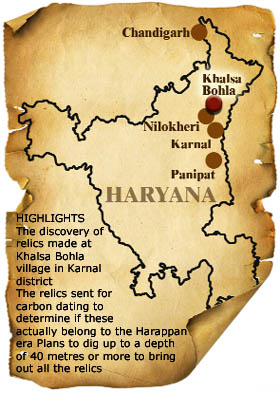
 A map shows the location of Khalsa Bohla village in Karnal district where relics have been excavated. Graphic: Rajbir Singh Nilokheri (Karnal), April 5 Archaeological experts from Banaras Hindu University (BHU) and Cambridge University, London, have dug out relics believed to be associated with the Harappan civilization. The discovery was made at Khalsa Bohla village in the district from a mound spread over 400 metres.

The excavation teams are being led by Arun Pandey of Banaras Hindu World School and historian Patrick from Cambridge University of London. Arun Pandey said the excavation was in the initial stages and they had dug up only four metres of land. He said the team had already found relics, including utensils, pottery and bones, which are believed to have been used by people belonging to the Harappan era. Pandey said the excavated relics had been sent for carbon dating to ascertain their exact age to determine if these actually belonged to the Harappan era.

The size and shape of utensils made of mud suggested that these were of the Harappan times. He said the team planned to dig to a depth of 40 metres or more to bring out all the relics. He claimed the excavation was being carried out carefully so that no damage was caused to any historical object.

Gumeet Singh, sarpanch of the village, said the excavation assumed significance as the epic war of Mahabharata was fought at this village and the excavated relics could date back to that period.

Monday, April 2, 2012

Job Opening: DD Kosambi Chair at Goa Univ

PANAJI: The Goa University (GU) has written to vice-chancellors of universities across the country in its lookout for senior and experienced professors to head the research chairs established recently in the honour of Goa's first chief minister D B Bandodkar, scholar D D Kosambi and noted Konkani poet Bakibab Borkar.

The chosen professors will be brought on deputation and appointed on contract basis for a total period of five years. The initial contract will be signed for three years and will be extendable by another two years after evaluation by a committee appointed by the Goa University.

While the research chair in the name of Bandodkar is in political economy in the Goa University's department of political science, the research chair in the name of Kosambi is in interdisciplinary studies in the department of history. The research chair in the name of late Kavivarya Bakibab alias B B Borkar is in comparative literature in the department of Konkani.

For the research chair in political economy, the Goa University is looking for professors who have published research work and articles in referred journals in the area of political economy. In case of the research chair in the name of D D Kosambi for interdisciplinary studies, the university is looking out for an applicant who is an eminent scholar from the areas of social sciences particularly in history, archaeology, indology, anthropology and having interdisciplinary/multidisciplinary perspectives in his published research work and articles in referred journals.

The research chair in the name of Bakibab Borkar will be headed by a professor who is a 'widely recognized intellectual in the field of comparative literature in India and/or outside India, who is a creative writer and winner of state or national level recognized award.'

Tuesday, March 6, 2012

Comprehensive tribute to man of many parts


by B. SURENDRA RAO

D.D. Kosambi was a rare genius. In a world that revels in narrow specialisation, he was truly a man of Renaissance versatility: a mathematician of distinction, a polyglot, a Marxist, an active member of the World Peace Council and a man who had strayed into Indian history (“… I had fallen into Indology, as it were, through the roof.”) and yet created a major paradigm shift there. He had creatively subverted — which means enriched — the understanding and writing of Indian history.

A whole generation of historians has harnessed his ideas to new areas and destinations, to test his theories and hypotheses, and drawing on not only his critical, scientific temperament but also his strong social commitment. That 45 years after his death his discerning admirers should yet join together to re-visit him shows how strong his impact is on Indian historiography. Professor D.N. Jha and the scholars who have participated in this academic venture and produced this book deserve our compliments.

The book has eight essays that touch upon the myriad aspects of Kosambi's work and legacy. D.N. Jha's essay highlights the various areas of Indian history which Kosambi upturned to achieve newer perspectives and refreshing harvests like numismatics, religious and secular literature, ethnography and even archaeology.

Though Kosambi was a Marxist, he refused to be dogmatically so. It was for him a method, a ‘tool of analysis' and not ‘a substitute for thinking.' He questioned the received Marxist notion of Asiatic Mode of Production and the simplistic slavery-feudalism-capitalism scheme of epochal progress. But Kosambi could identify features of feudalism in India, which, he believed, had its source both from below and from above, an idea which has been productively debated and cultivated in Indian historiography.

Irfan Habib's essay points out that for all his sturdy independence, Kosambi had accepted the universality of class struggle and hence the foundational idea of Marxism. But what he would not compromise with was the academic rigour with which to test a theory or a hypothesis. Irfan Habib gratefully acknowledges that “He opened doors for many of us to new ideas and new questions …”

ACCULTURATION

Not only did Kosambi adopt a framework in which to explain Indian history, but as Prabhat Patnaik shows in his brilliant essay, he extended the frontiers of dialectical materialism. His concept of ‘acculturation' by which the tribal societies were anaesthetically subjugated and sucked into the agrarian and hence class societies, was new to the usual Marxist analysis, which also proves the point that the theory is much more open-ended than its traducers would have us believe.

Kosambi's understanding of medieval India has been analysed by Eugenia Vanina, who takes up certain issues like ‘ahistoricity' of ancient and medieval India, the applicability of feudalism as an idea or the class character of medieval literature and argues for the need to extend the researches to areas such as culture, literature, mentalities, ethical values, and scientific views.

K.M. Shrimali's attempt to explore Kosambi's idea of religious histories of India is done by strenuously juxtaposing it with the work of Mircea Eliade. He points out that contrary to the belief that Marxism denies religion and culture, Kosambi sought to study religion in the larger historical contexts and as responding to various ideas. Suvira Jaiswal's essay on ‘Kosambi on Caste' takes up several strands of debates and shows how material conditions and ideologies together went into its making and consolidation.

Kesavan Veluthat in his essay points out that Kosambi, notwithstanding his uncharacteristic modesty about his facility in Sanskrit, was the first to analyse Sanskrit literature within the framework of historical materialism to show its class character. He contends that Sheldon Pollock's rejection of Kosambi's thesis is based on exceptions which proverbially prove the rule. The last essay by C.K. Raju deals with Kosambi's work on mathematics which the author interestingly and illuminatingly links with the status of science management in post-Independence India which has consecrated the idea and workings of hierarchy.

All the essays seek to reaffirm the place of Kosambi in Indian historiography. He could be faulted in matters of some details and judgments; but it is less important to criticise or defend them than acknowledge the shifts he had effected and the larger debt we owe him. Some critics have gleefully noticed his influence only with the Left, which at least concedes that scientific and critical history is possible with, and palatable to, a few.

THE MANY CAREERS OF D. D. KOSAMBI: Critical Essays: Edited by D. N. Jha; LeftWord Books, 12, Rajendra Prasad Road, New Delhi-110001. Rs. 275.

Monday, March 5, 2012

Renaissance man


Renaissance man
Mar 04, 2012 :
Lead review
This collection of essays manages to bring out various facets of a man who has been able to authoritatively comment on a wide range of topics, writes S Nanda kumar.

Damodar Dharmananda Kosambi was a remarkable person — mathematician, statistician, historian, numismatist and Sanskrit scholar — who lived between 1907 and 1966.

The Many Careers of D D Kosambi: Critical Essays is a collection of essays that throws more light on this rare and interesting human being.

Noted historian Prof D N Jha, who has
edited the book, says in his preface that the book attempts to bring together articles by scholars “who are neither allergic nor adulatory about the work of Kosambi.”

Through the essays, one is introduced to a man with the ‘renaissance’ type of versatility: a wide range of knowledge without sacrificing depth. This important choice was made when he was studying mathematics in Harvard University in the 1920s. The famous American mathematician George David Birkhoff told him to focus on this field.

He is said to have consulted his father, another versatile scholar, who agreed that he should instead acquire knowledge as widely as possible. Kosambi then went to take advantage of the freedom available in American universities to take 18 courses in a year!

In his essay, C K Raju writes that Kosambi’s refusal to specialise went against him, even at the beginning of his career, since “on the capitalist value of specialization, non-specialists are taken non-seriously.” The essays also underscore the loneliness of a man who refused to kowtow to authorities, or dabble in the politics that even academic institutions revel in.

Kosambi used his abstract mathematical methods to study various branches of social sciences. He studied numismatics purely to get a better grasp of statistics, and weighed nearly 12,000 coins for this exercise. Kosambi, through his detailed studies of coins, was able to reconstruct the social and economic history of India. For instance, the paucity of coinage in the post-Gupta period led him to link it with the decline of trade and the emergence of the self-sufficient village economy during the same period in history.

Kesavan Veluthat, a professor of history at Delhi University, who has written an essay on Kosambi’s contribution to Sanskrit, outlines how Kosambi took up the analysis of coins to solve a statistics problem, and states that he had used the famous Taxila hoards for this purpose. Kosambi found that the “written sources display a shocking discordance. The Puranas, Buddhist and Jain records give different names for the same king.” So, he decided to go into the records himself.

Veluthat quotes Kosambi as saying that he selected a specific work, Bhartihari’s Subhasitas. But Kosambi found that the philosophy of Bhartihari, as glorified by commentators, was at variance with his poetry of escape and frustration. He quotes Kosambi, “By pointing out this (variance) in an essay, which made every god-fearing Sankritist who read it shudder, I had fallen into Indology, as it were, through the roof.”

C V Raju’s essay brings out human facets of the man, who restlessly flitted from the Banaras Hindu University to the Aligarh Muslim University, and then to Fergusson College in Pune.

Kosambi was sacked from Fergusson’s on the alleged grounds that students did not understand the mathematics he was teaching. Finally, he met Homi Bhabha, who was expanding the Tata Institute of Fundamental Research (TIFR) at Mumbai, who offered him a lucrative job in pure research. Even at TIFR, Kosambi was sacked for playing a prank – albeit on a high intellectual plane – by publishing a proof of the Riemann hypothesis. He meant this as a joke. Kosambi continued to remain active in mathematics, and continued his work on probability and the number theory even after his removal from TIFR.

I do not know if Raju, in his essay, has sought to make an example of Kosambi’s sacking from TIFR for a debate on Nehru’s vision; or questioning Nehru’s packing the top three departments of atomic energy, space, and Council of Scientific & Industrial Research (CSIR) with the scions of leading industrial houses: Homi Bhabha, Vikram Sarabhai and the Birlas respectively.

Raju points out a very relevant fact — that Kosambi argued in vain for technology to be better adapted to the needs of Indian people, such as solar energy, small dams, even small reactors. All contrary to Nehru’s vision of mega projects — and we are, as Raju points out, still debating this even today.

That Kosambi belonged to a tight group of Marxist scholars who were against many of Nehru’s ideas makes it more difficult to understand in today’s era, when there is no USSR, and when China, a country that was impressed by some of Kosambi’s thoughts, is relentlessly pursuing capitalist methods of capturing the world market.

While there is no doubt that the essays in this book bring out fascinating facets of Kosambi, they might only interest those who are of a more academic bent of mind. Some of the essays are beyond the common man’s grasp, and are too scholarly and specialised.

The essays, however, do manage to bring out captivatingly the man who was able to comment on the caste system, Sanskrit, numismatics, the religious history of India, on how Bhartihari’s poetry resonated with “the groans of the oppressed man,” and of course, his contributions to mathematics. Common readers like myself can only marvel at Kosambi, the man, the mathematician, the historian, and believer in world peace.

I certainly have been captivated by the remarkable D D Kosambi, and do hope that somebody would soon undertake the task of writing a faithful biography of the man that will reach the common masses, rather than specialised tomes on him that adorn just the bookshelves of mathematicians, scholars and Marxists.

Friday, February 3, 2012

Monk, Mathematician, Marxist

Monk, Mathematician, Marxist
How the talented Kosambis made India modern
By ANANYA VAJPEYI
Published :1 February 2012

Source

COURTESY PERMANENT BLACK
Dharmanand Kosambi (left) may be described as a scholar and proselytiser of Buddhism and a practicing Buddhist, a Gandhian, and a feminist. The polymathic DD Kosambi (right) was a mathematician, a historian and a Marxist.


I NDIA HAS REMADE ITSELF at least twice in the past 100 years. The economic and political character of the country, which was of a colonial-nationalist nature in the early 20th century, became Nehruvian-socialist after Independence and then shifted again toward globalising neoliberalism in the last decade of the century. An effective way to track the cultural effects of these very large shifts is to compare the trajectories of successive generations of Indians. The lives of the extraordinary father-son duo of Dharmanand Kosambi (1876-1947) and Damodar Dharmanand or DD Kosambi (1907-1966), both brilliant scholars and pioneers of entire fields of study, vividly illustrate the first great transformation of modern India, effected over the course of the 1950s and early 1960s, during three administrations under Jawaharlal Nehru.

The recent translation of several of Dharmanand’s Marathi writings, including his partial autobiography Nivedan (A Narrative): 1912-1924 (Permanent Black, 2011), and a broad retrospective exercise by a number of contemporary historians occasioned by Damodar’s birth centenary in 2007, allow us to follow Kosambi père and fils in some detail, and through them to view the changing historical contexts in which they were embedded. Dharmanand’s granddaughter and DD Kosambi’s daughter, Meera Kosambi, herself a sociologist specialising in urban studies and women’s studies, and an accomplished translator between Marathi and English, has in the past two years helped bring both her eminent forbears back into focus for students of modern India.

Father and son were polymaths, and in this regard they remind us of other talented public figures in South Asia prior to Independence, like the poet Rabindranath Tagore (1861-1941) and the art historian Ananda K Coomaraswamy (1877-1947). Together and individually, the Kosambis also exemplify a confluence of intellectual streams that coloured the biographies of a large number of prominent Indians, men and women, in the first three quarters of the 20th century: Buddhism, Marxism, Gandhianism and Socialism. For reasons that remain culturally and sociologically under-studied and have as yet to get any sort of systematic treatment in the intellectual history of modern India, some blend of these ideological currents impacted a range of thinkers and leaders, from BR Ambedkar to Ram Manohar Lohia, Narendra Dev to Rahul Sankrityayana, Jai Prakash Narayan to Hazari Prasad Dwivedi, Vinoba Bhave to JB Kripalani.

In fact, if we take widespread influence of Gautama Buddha, Karl Marx and Mahatma Gandhi on intellectual elites in the founding generations seriously, as we ought, then it becomes very difficult to figure out how, against their inclinations, we arrived at the second great transformation of India into a globalised free-market economy with powerful rightwing political forces active in it. It is as though all of the genuinely egalitarian and emancipatory tendencies within politics, that had an organic relationship with Indian political thought on the one hand and that could have made possible a properly Indian social revolution on the other, somehow foundered before they could flourish. As late capitalism makes its relentless advance into India and the left is driven further and further into the political wilderness, it does us good to remember the nuance and the promise of a more complex time, scarcely half a century ago, when unusual men like the Kosambis were included in the intellectual leadership of this country.

If we aim for brevity, Dharmanand Kosambi may be described as a scholar and proselytiser of Buddhism and a practicing Buddhist, a Gandhian, and a feminist; DD Kosambi may be described as a mathematician, a historian and a Marxist. Both men, born Brahmins, had pronounced linguistic abilities, and especially loved Sanskrit. Both moved around within India and South Asia, and also travelled the world, but must be seen as rooted primarily in the cultural ground of greater Maharashtra (including Marathi, Gujarati, Kannada, Hindi and Konkani-speaking areas, and the former princely states of Indore, Gwalior and Baroda). Both had intellectually significant, if not definitive experiences at Harvard University—the father as a philologist of Buddhist texts, the son as a student of mathematics. It doesn’t seem as though they had a very warm or expressive bond with one another as parent and child; nevertheless, they were profoundly similar to and connected with one another in terms of their intellectual personalities. Between them they shaped the disciplines of Buddhist studies, Indology, history, archeology, numismatics and mathematics in India; the imprint of Marxism—whether as class analysis, dialectical method, or a critique of caste—is all over their work.

But despite commonalities and continuities between Dharmanand and Damodar Kosambi, what emerges from the former’s autobiography, Nivedan, translated and edited by Meera Kosambi, and from the volume The Many Careers of DD Kosambi: Critical Essays, edited by noted historian DN Jha (Left Word, 2011), is that there had been a sea change in India between the time when the father was a young man and the time when his son came of age. Dharmanand wandered in a country where Buddhism as discourse or as practice was all but extinct; where almost all his personal contacts and professional networks consisted of fellow Brahmins who housed, clothed and fed him as he went from city to city in search of Buddhism; where Hindu mathas and Buddhist viharas dotted the landscape through which he travelled—from Goa in the west to Burma in the east, from Nepal in the north to Sri Lanka in the south. The scholastic terrain of India was still largely unchanged from precolonial times.

By contrast Damodar navigated a very different academic territory, one dotted with prestigious colonial establishments such as the Fergusson College in Pune, institutions that were a product of the nationalist movement such as the Aligarh Muslim University and the Banaras Hindu University, as well as emerging Nehruvian institutions such as the Tata Institute for Fundamental Research (TIFR) in Mumbai. Traditional learned classes—Brahmins, Kayasthas and residual Buddhists had given way, within the space of scarce two or three decades, to a modern knowledge elite of physical and social scientists, as well as technocrats charged with building a range of institutions for the new nation-state. Ancient Buddhism, long vanished, had reappeared in a variety of postcolonial guises, from the Navayana (‘New Way’) of Babasaheb Ambedkar, to other sects flowing back into India from Tibet, Sri Lanka, Burma, Thailand, Japan as well as the Anglo-American West. With the demise of the British Empire, colonialism, together with its Orientalist and Indological apparatuses, had packed up and gone home, leaving independent India in charge of its own cultural pasts as much as it was now responsible for its own political futures.

A S A GRADUATE STUDENT SOME YEARS AGO, I would spend months on end in Pune, reading Sanskrit and Marathi texts, and travelling around in Maharashtra, as well as in neighbouring Karnataka and Goa, in search of archives, individuals and institutions connected with my research. Between 1998 and 2003 I journeyed up and down the Deccan landscape and the Western Ghats, mostly by road or rail. The spirit of DD Kosambi was often with me on my forays into this—to me—unfamiliar part of the country. On one of my earliest trips to Pune, a friend introduced me to Meera Kosambi, who invited me to see her father’s house off Law College Road, where I would go almost every day to the Bhandarkar Oriental Research Institute.

The Kosambi residence was built in a coastal Goan style, its sloping roof covered with rounded red tiles of baked clay, a central courtyard open to the elements, and a covered verandah running around all four sides of the house. The large front room was set up as the late Damodar Kosambi’s study, with a number of books, papers, pens, paperweights, inkstands and other things lying on his large desk as though he had just left the room and gone into a different part of the house. But behind his chair hung a very large photographic portrait of him, reminding us that he had—already, at that time—been dead for well over 30 years. Perhaps there were photos of Dharmanand too, though I have no recollection of seeing them, nor would I have known, then, who I was looking at. Later I learned that the house had been sold to builders, who demolished it and replaced it with a block of apartments; I could not bring myself to go and see the place in its new avatar.

Pune is one of the many smaller cities in India that has found its historic architecture under severe stress over the past two decades. Just in the 12 or 15 years that I have been going there for my scholarly work, its graceful edifices and sleepy neighbourhoods, and with them their ways of life, have been vanishing before one’s eyes. But that Pune city, Maharashtra state or indeed the Indian government let the Kosambi home, built circa 1931, go the way of other old buildings is a sad commentary on our inability to recognise and respect the landmarks of our intellectual life and cultural history. A recent trip to Simla, where I saw an incredibly decrepit house called ‘Wood Field’ that Rabindranath Tagore had vacationed in, in 1893-94, together with other members of his illustrious family, and where he wrote a number of the poems in his collection Shonaar Taari (The Golden Boat), filled me with the same despair that I invariably feel in Pune: as a culture, we fail to honour and commemorate our greatest minds.

Indian history as a discipline was dominated by Marxism for so long—from the 1960s through the 1990s—that most leading historians over two generations, at universities such as the Jawaharlal Nehru University and Aligarh Muslim University, as well as a number of campuses in West Bengal, have studied DD Kosambi thoroughly, and had the opportunity to both learn from him as well as critique his methods and findings. A July 2008 special issue of the Indian social science journal, Economic and Political Weekly (EPW), brought together a symposium on DD Kosambi’s work as a historian. Historiography within Maharashtra and of Maharashtra and the Deccan, as an important subset of Indian history, has benefited especially from his insights and innovations—those who read Marathi can access the rich debates there. It is good that at last he is also being assessed seriously from the perspective of other disciplines to which he contributed so much: Sanskrit philology, archaeology, numismatics, anthropology, religion and—unusually—mathematics and statistics.

Particularly interesting, in both the EPW (2008) issue as well as the recent DN Jha edited volume, are the essays by CK Raju, which walk us through some of the more technical aspects of Damodar’s mathematical gifts even while recounting his misadventures in the Indian science academy. In Raju’s telling, DD Kosambi must be seen as an early figure of dissent in Indian mathematics and science. He had significant mathematical abilities, which might have been encouraged in another country, but were only thwarted in India. It did not help that Damodar was a serious pacifist and spoke out publicly against the dangers of nuclear power (including its potentially harmful side effects on the genetic structure of human and other life forms—a prescient warning that no one heeded at the time or is likely to heed now, for that matter). His would-be patrons, the physicist Homi Bhabha, the father of India’s atomic energy programme, and the industrial family of the Tatas, eventually denied him tenure at TIFR, alleging that he had failed to solve a particular mathematical problem, and adding on the snide caveat that relieved of his scientific job, he would be better able to devote his time to his other interest, history—an insult to him both as a mathematician and as an historian that is infuriating to read about even today. This after Damodar had won the Raman Prize in 1934 and the Bhabha Prize in 1947 for his mathematical work!

In fact, two things stand out consistently about the man: first, his undoubted genius, the gifted and multi-faceted quality of his imagination; and second, his inability to function within institutional contexts populated by lesser minds and their propensity to play petty politics. Clearly, as a scholar, Damodar was brilliant, eccentric, prolific and even playful; but as an academic he was also condemned to a rather solitary existence, unable to find colleagues, interlocutors or students who might have kept up with his astonishing inventiveness. With the passage of time, DD Kosambi’s polymathic intellect stands vindicated; but it has to be said that the condition of Indian academia, especially of prestigious institutions meant for specialised research, has only deteriorated in the half century since his death. If extraordinarily talented individuals like him were undervalued, isolated or actively persecuted by the academic establishment in the 1950s and 1960s, they are likely to be even worse off today. Interdisciplinary abilities have never been nurtured or rewarded in our postcolonial systems of higher education.

Dharmanand, however, presents a rather different sort of an enigma. In him we see a thirst for Buddhism that propels him into arduous journeys—away from his native caste background and ethnic, regional identity as a rural Goan; often outside of India to neighbouring countries in South Asia; into languages that for him, a high-school dropout, have to be diligently learnt: Marathi, Sanskrit, Pali and English (for starters); and last but not least, away from his family, including his wife and children, for long periods of time. He seems to grapple with a genuine struggle between the responsibilities of bourgeois domesticity and the rigors of a monastic life. His health is in ruins from extreme poverty, his innate asceticism, the physically grueling nature of his travels and his exercises in bodily self-discipline. Some inner fire compels him to both try to master Buddhism and spread its message among his indifferent countrymen.

Surely a comparative study of the Buddhist zeal of the Brahmin Dharmanand and the Untouchable Ambedkar, both active in Maharashtra in the first half of the 20th century, is crying out for the attentions of a PhD candidate somewhere. Now that more and more of Dharmanand’s writings are becoming available to us in translation, we may begin a systematic analysis of the biography and work of this strange, tortured, questing individual who finally gave up his life in an act of voluntary starvation (following the Jain practice known as sallekhana) in Gandhiji’s ashram at Wardha in early June 1947. Meera Kosambi’s ‘Introduction’ to her grandfather’s Essential Writings (Permanent Black, 2010), as well as to his autobiography in its new freestanding and paperback edition, both open the door onto a potentially rich area of research and scholarship in modern Indian intellectual history.

T O GRASP THE ASTONISHING DIVERSITY of DD Kosambi’s interests and talents requires nothing more than a glance at the table of contents of his Exasperating Essays: Exercises in the Dialectical Method (People’s Publishing House, 1957). This slim little volume contains pieces on, among other topics, the trial of Socrates, the Cultural Revolution in China, the quality of renunciation in the work of the Sanskrit poet Bhartihari (whom he compares and contrasts with Dante and Goethe), the relationship between scientific knowledge and class society, the reasons for the decline of Buddhism in ancient India, imperialism and peace in a post-war world, and a critique of Nehru’s The Discovery of India (1946) from a Marxist perspective. The breadth of Damodar’s interests is breathtaking, as also the ease with which he writes about both contemporary issues as well as scholarly matters. Few intellectuals exhibit this kind of supple, capacious curiosity about past and present, India and the world, science and literature today—Ashis Nandy comes to mind as a rare exception, and certainly it is hard to think of anyone in the younger generation who will confidently take on this range of subjects. As India’s economy opens itself to global markets, what accounts for the closing of the Indian mind?

Dharmanand’s writings, as evidenced in the selection made by his granddaughter, hew closer to his principal areas of commitment and concern: Buddhist texts and history, nonviolence both Ashokan and Gandhian, and the incipient labour movement in India during the final decades of the British Raj. The father has an implacable seriousness; the son can take more liberties because in a sense his father’s struggles and privations have created a space in which he may pursue whatever topic engages or excites him with a degree of ease. The father was born in a small village in Goa and never even made it through secondary school; the son went to college at Harvard and spent most of his life as a middle-class professor in Mumbai and Pune. While Damodar’s brilliance is undeniable, perhaps it would be fair to say that the greater distance covered, the bigger achievement, was really that of Dharmanand.

Given the welter of areas of intellectual endeavour in which the Kosambis participated, Dharmanand’s greatest contribution was to the revival and spread of the message of Buddhism in Maharashtra; Damodar’s was to the opening of Indian history to class analysis and dialectical materialism. Both these are truly significant interventions, although for different reasons and in different ways. Arguably Dharmanand’s Marathi writings on Buddhism, including his primer Buddha, Dharma ani Sangha (1910) and his play Bodhisattva, published posthumously in 1949, prepared the ground for the eventual popularisation of Ambedkar’s Neo-Buddhism in Maharashtra in the late 1950s, after Ambedkar’s formal conversion of himself and of about 400,000 Untouchable followers in October 1956, just prior to his death in December that year. Dharmanand helped create a climate of ideas, in which once again after a hiatus of centuries it became possible for ordinary people to reimagine and identify with the life and words of Siddhartha Gautama, and for them to aspire to creating a more equitable society based on the Buddha’s teachings about freedom, community and what it means to be human. The story of Buddhism’s modern rebirth in the land of its original birth, India, has a special chapter that unfolds in Maharashtra, and surely this owes as much to Dharmanand Kosambi as it does to BR Ambedkar.

DD Kosambi, as is relatively better known, transformed Indian history as a discipline by advocating for the integration of the study of material artifacts with the study of texts; by taking the category of ‘tribe’ as seriously as others had previously taken the category of ‘caste’; by introducing the ‘class’ into our understanding of Indian social structure; by finding innovative ways to read literary, religious and mythical textual materials as part of the historical record without getting bogged down in imponderable questions about their own historicity; and by continually placing India in a broad comparative perspective along with other ancient and modern societies. Even a casual student of history in this country has the two celebrated snapshots of Damodar’s scholarly life imprinted on his or her memory: his walks in and around Pune, carrying a walking stick with which he probed the ground, turning up all kinds of objects and fragments, literally feeling his way through the layers of historical time upon which we stand; and his regular train rides between Pune and Mumbai on the Deccan Queen, which allowed him a physical view of Maharashtra’s landscape that over the years yielded a subtle and complex historical vision. DD Kosambi showed that history has to be rooted in the earth on which it unfolds—a valuable, indeed indispensable corrective to a scholarly culture otherwise driven and shaped by the Brahminical preference for abstraction over materiality and text over lived experience.

The first half of the 20th century, an exciting and as yet mostly uncharted period in India’s intellectual history, produced many families that were active in political and intellectual life—the Nehrus, the Tagores and the Bhandarkars come immediately to mind. To this list we must add the Kosambis, over not just two but now three generations. After almost 65 years of political independence and a good two decades into globalisation, it is hard to imaginatively reconstruct, today, a time when a young man could wander the length and breadth of South Asia and be genuinely surprised, discombobulated and inspired by the cultural diversity he encountered along the way; a time when the seeds of history still lay scattered and expectant underneath the surface of our collective consciousness, awaiting the ministrations of a perceptive and careful farmer to flower into a vivid picture of our past, and a warrant for our future flourishing.

Ananya Vajpeyi is a visiting fellow at the Centre for the Study of Developing Societies in New Delhi in 2011-12. Her book, Righteous Republic: The Political Foundations of Modern India, is forthcoming.

Thursday, February 2, 2012

The Many Careers Of D.D. Kosambi- A Review

Source: Outlook

Historian, statistician, Indologist, polyglot—there is a datedness to his political verities, but the scholar lives
DILEEP PADGAONKAR

The Many Careers Of D.D. Kosambi Critical Essays
By
Edited By D.N. Jha
LeftWord | Pages: 203 | Rs. 275


The name of Damodar Dharmananda Kosambi hardly rings a bell beyond a small circle of Marxist scholars—a circle that has shrunk with the implosion of the Soviet empire, China’s tight embrace of the market economy and the rout of Communist parties around the globe. Another reason for his limited appeal, paradoxically, is the sheer range and complexity of his intellectual pursuits. He was, at one and the same time, a mathematician and a statistician, an economic and social historian, an Indologist and a major contributor to the studies on genetics and numismatics. Moreover, he excelled as a polyglot—his peers envied his mastery over several classical and modern languages—and, not the least, as a ‘public intellectual’ who commented on issues of topical relevance with an unmatched flair for polemics.

Interest in Kosambi’s multi-faceted work revived briefly on the occasion of his birth centenary in 2007. Universities across India held seminars to subject it to critical scrutiny. That exercise was also conducted in the pages of academic journals. The articles reappraised his vast output in the light of newer insights that scholars had gained in their respective fields of endeavour following his death in 1966. However, some of them, including, especially, those published in a special issue of the Economic and Political Weekly, bordered on the scurrilous. This book, edited by D.N. Jha, the distinguished Marxist historian, seeks to restore the balance.

The result is a mixed bag. Drawn from various disciplines, the eight contributors present Kosambi’s achievements without succumbing to the twin temptations of gratuitous insult or obsequiousness. Jha’s own introductory essay offers an excellent overview of his life and work in a style that is accessible to the general reader. And yet, to our great relief, the style is singularly free of the virus of ‘popular’ writing—conversational, slang-ridden, crowded with cliches, laced with platitudes—that infects so many columns of newspapers and newsmagazines.

Some of the essays, however, are far too technical in nature, notably those that focus on Kosambi’s writings on Indology and mathematics. They demand a level of expertise that is out of reach for anyone but a scholar. Likewise, readers not entirely familiar with the intricacies of Marxist thought—or rather with the tedious squabbles over what Marx or some Marxist or the other actually meant—will find themselves in a befuddled state as they attempt to come to grips with a text that discusses, say, the “frontiers of historical materialism”.

But other essays do provide a respite, notably Irfan Habib’s fine piece entitled ‘What Kosambi Gave Us’. Even as he rebuts the critics of Kosambi, he does not hesitate to express his own scepticism about the theses of this Renaissance Man on certain issues like caste, Indian feudalism, ‘Asiatic Despotism’ and Brahminism. On this latter score, Kosambi was ruthless in denouncing Brahmins and Brahminism for lending legitimacy to unjust social structures—a feat all the more remarkable given the fact that he himself belonged to the Gowd Saraswat Brahmin community.

Where this book disappoints is on its failure to address Kosambi’s role as a public intellectual. In his anti-imperialist and anti-colonial zeal—which few can question given the conduct of the West during the Cold War period—he chose to look the other way when evidence of the crimes perpetrated by totalitarian Communist regimes came to light. He had not a harsh word to say about the way these regimes choked voices of dissent or about the follies of economic policy that brought untold misery to millions of people. The word Gulag apparently was a mere trifle in his reckoning.

All the same, this collection of essays is to be commended for the possibilities it opens up for a new generation of scholars—Marxists and non-Marxists alike—to build on Kosambi’s ideas and insights. This will arm them to ask tough questions about injustices and inequities that prevail in every nook and cranny of the country today, thus making a mockery of the highfalutin rhetoric of a ‘resurgent India’. The remedy for the ills afflicting the nation lies, to use John Kenneth Galbraith’s memorable phrase, in “comforting the afflicted and afflicting the comfortable”—but without the ideological blinkers that sometimes distorted his generous and enlightened vision.

(Dileep Padgaonkar is consulting editor, Times of India.)

Monday, January 30, 2012

5th D D Kosambi Festival of Ideas from February 7

DD Kosambi Lectures begin Feb 07, 2012

2012-01-25

The 5th D.D. Kosambi Festival of Ideas will commence from 7th February 2012 at Kala Academy,  Campal, Panaji – Goa. This year, the Directorate of Art & Culture has invited world renowned personalities from various fields for delivering lectures of substantial knowledge.

This year the Directorate of Art & Culture has invited the following Speakers: 
Smt. Uma Dasgupta, D.Phil (Oxon.) is an Eminent Author and former Research Professor, Social Sciences Division, Indian Statistical Institute, Kolkata. She has edited The Oxford India Tagore: Selected Writings on Education and Nationalism (OUP 2009), Rabindranath Tagore: My Life in My Words (Penguin Books, 2006), A Difficult Friendship: Letters of Edward Thompson and Rabindranath Tagore 1913–1940 (OUP 2003). She is the author of Rabindranath Tagore: A Biography (OUP 2004).

Smt. Medha Patkar (Active Social Activist and Environmentalist), She is known for her role in Narmada Bachao Andolan. She has also filed a public interest petition in the Bombay High Court against Lavasa along with other members of National Alliance of People's Movements (NAPM), including Anna Hazare. 

Shri Shekhar Singh (Founder member, National Campaign for People’s Right to Information (NCPRI)), Has worked with the government in various capacities, including as advisor to the Planning Commission of India on environment and forests, chairman of the Environmental Appraisal Committee for Power Projects of the Government of India, and as Supreme Court appointed commissioner on forestry and related matters for the Andaman and Nicobar Islands.

Shri Saeed Naqvi (Senior Journalist and Distinguished Fellow at Observer Research Foundation, New Delhi) His articles appear in various newspapers in India and abroad. Parvin Fellow at the Woodrow Wilson School of Public and International Affairs, Princeton University, US. Studied Journalism at the Thomson School of Journalism, Cardiff, UK. Graduated from Delhi University. School, La Martiniere, Lucknow.

Prof Muhammad Yunus (Noble Laureate, Acclaimed Economist and Chairman of Yunus Center, Grameen Bank). He is dedicated to eradicate poverty. Against the advice of banks and government, Yunus carried on giving out 'micro-loans', and in 1983 formed the Grameen Bank, meaning 'village bank' founded on principles of trust and solidarity. 

In Bangladesh today, Grameen has 2,564 branches, with 19,800 staff serving 8.29 million borrowers in 81,367 villages.

The Directorate of Art & Culture had initiated the D.D. Kosambi Festival of Ideas to commemorate the birth Centenary of the legendary Damodar Dharmanand Kosambi the Indian mathematician, statistician, historian, and polymath who contributed to genetics by introducing Kosambi's map function. He is well-known for his work in numismatics and for compiling critical editions of ancient Sanskrit texts. D.D. Kosambi was also a Marxist historian specializing in ancient India who employed the historical materialist approach in his work. He is described as "the patriarch of the Marxist school of Indian historiography".

He was an enthusiast of the Chinese revolution and its ideals, and, in addition, a leading activist in the World Peace Movement. This Festival is the only one of its kind in the Country.

The inaugural talk at the 1st D.D. Kosambi Festival of Ideas - 2008 was delivered by H.E.Hamid Ansari, Hon. Vice President of India. This was followed by talks by Prof. Romila Thapar – eminent Historian, Meera Kosambi – scholar and daughter of D.D. Kosambi,  P. Sainath – Magsaysay award winner, Journalist and Dr. Vivek Monteiro, a well-known Scientist.

The 4th D. D. Kosambi comprised of colossuses like Dr. Raghunath Mashelkar (Eminent
Scientist of India and President of Global Research Alliance), His Excellency Dr. A.P. J. Abdul
Kalam (Former President of India and Eminent Scientist), His Holiness The Dalai Lama (World renowned spiritual leader and crusader of Peace), Lord Meghnad Desai (Indian- born British economist and acclaimed intellect), Justice Albie Sachs (Former Judge on the

Constitutional Court of South Africa and active Human right activist) and Dr. Karan Singh (Hon. MP of Rajya Sabha and President of ICCR).

The interaction sessions between the public and the speakers is held subsequent to the talk delivered by the speaker to elucidate any doubts in the minds of the people.

The Directorate of Art & Culture requests all the people of Goa to exploit the potential of these illustrious personalities, gain knowledge imparted by them by attending the lectures in large numbers.

Related Report


The 5th DD Kosambi Festival of Ideas will commence from February 7 at Kala Academy, Campal, Panaji. This year, the Directorate of Art and Culture has invited personalities from various fields.

The speakers include Uma Dasgupta, Medha Patkar, Shekhar Singh, Saeed Naqvi and Prof Muhammad Yunus.

Uma Dasgupta is an eminent author and former research professor, social sciences division, Indian Statistical Institute, Kolkata. She has edited The Oxford India Tagore: Selected Writings on Education and Nationalism, Rabindranath Tagore: My Life in My Words, A Difficult Friendship: Letters of Edward Thompson and Rabindranath Tagore 1913–1940, and is the author of Rabindranath Tagore: A Biography.

Medha Patkar is known for her role in Narmada Bachao Andolan. She has also filed a public interest petition in the Bombay High Court against Lavasa along with other members of National Alliance of People's Movements , including Anna Hazare.
 

Shekhar Singh has worked with the government in various capacities, including as advisor to the Planning Commission of India on environment and forests, chairman of the Environmental Appraisal Committee for Power Projects of the Government of India, and as Supreme Court appointed commissioner on forestry and related matters for the Andaman and Nicobar Islands.
 

Saeed Naqvi articles appear in various newspapers in India and abroad. He studied journalism at the Thomson School of Journalism, Cardiff, UK and graduated from Delhi University, School La Martiniere, Lucknow.
 

Prof Muhammad Yunus is dedicated to eradicating poverty. Against the advice of banks and government, Yunus carried on giving out 'micro-loans', and in 1983 formed the Grameen Bank, meaning 'village bank' founded on principles of trust and solidarity. In Bangladesh today, Grameen has 2,564 branches, with 19,800 staff serving 8.29 million borrowers in 81,367 villages.

The Directorate of Art and Culture had initiated the D D Kosambi Festival of Ideas to commemorate the birth Centenary of the legendary Damodar Dharmanand Kosambi


Friday, January 20, 2012

Integrating Mathematics and History- The Scholarship of DDK

by Ramakrishna Ramaswamy

Today, D D Kosambi’s significance as a historian greatly overshadows his reputation and contributions in mathematics. Kosambi simultaneously worked in both areas for much of his adult life, and to understand the body of his work either in the social sciences or in mathematics, an appreciation of the complementarity of his interests is essential. An understanding of Kosambi the historian can only be enhanced by an appreciation of Kosambi the mathematician. In a fundamental way, Kosambi embodied the multidisciplinary approach, channelling diverse interests – indeed combining them – to create scholarship of high order.

Download the full paper

Thursday, December 29, 2011

Understanding ancient Indian mathematics

This topic lies at the intersection of DD Kosambi's twin interests in ancient Indian history and mathematics.

Source:http://www.thehindu.com/sci-tech/science/article2747006.ece

It is high time we studied our mathematical heritage with diligence and objectivity

By S.G. DANI

A portion of a dedication tablet in a rock-cut Vishnu temple in Gwalior built in 876 AD. The number 270 seen in the inscription features the oldest extant zero in India.

Caption: A portion of a dedication tablet in a rock-cut Vishnu temple in Gwalior built in 876 AD. The number 270 seen in the inscription features the oldest extant zero in India.

Quite often I find that conversations, with people from various walks of life, on ancient Indian mathematics slide to “Vedic mathematics” of the “16 sutras” fame, which is supposed to endow one with magical powers of calculation. Actually, the “16 sutras” were introduced by Bharati Krishna Tirthaji, who was the Sankaracharya of Puri from 1925 until he passed away in 1960, associating with them procedures for certain arithmetical or algebraic computations. Thus, this so-called “Vedic mathematics (VM)” is essentially a 20th century phenomenon.

Neither the “sutras” nor the procedures that they are supposed to yield, or correspond to, have anything to do with either the Vedas, or even with any post-Vedic mathematical tradition of yore in India. The image that it may conjure up of ancient rishis engaged in such arithmetical exercises as are taught to the children in the name of VM, and representing the solutions through word-strings of a few words in modern styled Sanskrit, with hardly any sentence structure or grammar, is just too far from the realm of the plausible. It would have amounted to a joke, but for the aura it has acquired on account of various factors, including the general ignorance about the knowledge in ancient times. It is a pity that a long tradition of over 3,000 years of learning and pursuit of mathematical ideas has come to be perceived by a large section of the populace through the prism of something so mundane and so lacking in substance from a mathematical point of view, apart from not being genuine.

Tall claims

The colossal neglect involved is not for want of pride about the achievements of our ancients; on the contrary, there is a lot of writing on the topic, popular as well as technical, that is full of unsubstantiated claims conveying an almost supreme knowledge our forefathers are supposed to have possessed. But there is very little understanding or appreciation, on an intellectual plane, of the specics of their knowledge or achievements in real terms.

In the colonial era this variety of discourse emerged as an antithesis to the bias that was manifest in the works of some Western scholars. Due to the urgency to respond to the adverse propaganda on the one hand and the lack of resources in addressing the issues at a more profound level on the other, recourse was often taken to short-cuts, which involved more assertiveness than substance. There were indeed some Indian scholars, like Sudhakar Dvivedi, who adhered to a more intellectual approach, but they were a minority. Unfortunately, the old discourse has continued long after the colonial context is well past, and long after the world community has begun to view the Indian achievements with considerable objective curiosity and interest. It is high time that we switch to a mode betting a sovereign and intellectually self-reliant society, focussing on an objective study and critical assessment, without the reference frame of “what they say” and how “we must assert ourselves.”

Ancient India has indeed contributed a great deal to the world's mathematical heritage. The country also witnessed steady mathematical developments over most part of the last 3,000 years, throwing up many interesting mathematical ideas well ahead of their appearance elsewhere in the world, though at times they lagged behind, especially in the recent centuries. Here are some episodes from the fascinating story that forms a rich fabric of the sustained intellectual endeavour.

Vedic knowledge

The mathematical tradition in India goes back at least to the Vedas. For compositions with a broad scope covering all aspects of life, spiritual as well as secular, the Vedas show a great fascination for large numbers. As the transmission of the knowledge was oral, the numbers were not written, but expressed as combinations of powers of 10. It would be reasonable to believe that when the decimal place value system for written numbers came into being it owed a great deal to the way numbers were discussed in the older compositions.

The decimal place value system of writing numbers, together with the use of ‘0,' is known to have blossomed in India in the early centuries AD, and spread to the West through the intermediacy of the Persians and the Arabs. There were actually precursors to the system, and various components of it are found in other ancient cultures such as the Babylonian, Chinese, and Mayan. From the decimal representation of the natural numbers, the system was to evolve further into the form that is now commonplace and crucial in various walks of life, with decimal fractions becoming part of the number system in 16th century Europe, though this again has some intermediate history involving the Arabs. The evolution of the number system represents a major phase in the development of mathematical ideas, and arguably contributed greatly to the overall advance of science and technology. The cumulative history of the number system holds a lesson that progress of ideas is an inclusive phenomenon, and while contributing to the process should be a matter of joy and pride to those with allegiance to the respective contributors, the role of others also ought to be appreciated.

It is well-known that Geometry was pursued in India in the context of construction of vedis for the yajnas of the Vedic period. The Sulvasutrascontain elaborate descriptions of construction of vedis and enunciate various geometric principles. These were composed in the rst millennium BC, the earliest Baudhayana Sulvasutra dating back to about 800 BC. Sulvasutra geometry did not go very far in comparison to the Euclidean geometry developed by the Greeks, who appeared on the scene a little later, in the seventh century BC. It was, however, an important stage of development in India too. The Sulvasutra geometers were aware, among other things, of what is now called the Pythagoras theorem, over 200 years before Pythagoras (all the four major Sulvasutras contain an explicit statement of the theorem), addressed (within the framework of their geometry) issues such as nding a circle with the same area as a square and vice versa, and worked out a very good approximation to the square root of two, in the course of their studies.

Though it is generally not recognised, the Sulvasutra geometry was itself evolving. This is seen, in particular, from the differences in the contents of the four major extant Sulvasutras. Certain revisions are especially striking. For instance, in the early Sulvasutra period the ratio of the circumference to the diameter was, as in other ancient cultures, thought to be three, as seen in a sutra of Baudhayana, but in the Manava Sulvasutra, a new value was proposed, as three-and-one-fth. Interestingly, the sutra describing it ends with an exultation “not a hair-breadth remains,” and though we see that it is still substantially off the mark, it is a gratifying instance of an advance made. In the Manava Sulvasutra one also nds an improvement over the method described by Baudhayana for nding the circle with the same area as that of a given square.

The Jain tradition has also been very important in the development of mathematics in the country. Unlike for the Vedic people, for Jain scholars the motivation for mathematics came not from ritual practices, which indeed were anathema to them, but from the contemplation of the cosmos. Jains had an elaborate cosmography in which mathematics played an integral role, and even largely philosophical Jain works are seen to incorporate mathematical discussions. Notable among the topics in the early Jain works, from about the fifth century BC to the second century AD, one may mention geometry of the circle, arithmetic of numbers with large powers of 10, permutations and combinations, and categorisations of innities (whose plurality had been recognised).

As in the Sulvasutra tradition, the Jains also recognised, around the middle of the rst millennium BC, that the ratio of the circumference of the circle to its diameter is not three. In “Suryaprajnapti,” a Jain text believed to be from the fourth century BC, after recalling the “traditional” value three for it, the author discards that in favour the square root of 10. This value for the ratio, which is reasonably close to the actual value, was prevalent in India over a long period and is often referred as the Jain value. It continued to be used long after Aryabhata introduced the well-known value 3.1416 for the ratio. The Jain texts also contain rather unique formulae for lengths of circular arcs in terms of the length of the corresponding chord and the bow (height) over the chord, and also for the area of regions subtended by circular arcs together with their chords. The means for the accurate determination of these quantities became available only after the advent of Calculus. How the ancient Jain scholars arrived at these formulae, which are close approximations, remains to be understood.

Jain tradition

After a lull of a few centuries in the early part of the rst millennium, pronounced mathematical activity is seen again in the Jain tradition from the 8th century until the middle of the 14th century. Ganitasarasangraha of Mahavira, written in 850, is one of the well-known and inuential works. Virasena (8th century), Sridhara (between 850 and 950), Nemicandra (around 980 CE), Thakkura Pheru (14th century) are some more names that may be mentioned. By the 13th and 14th centuries, Islamic architecture had taken root in India and inGanitasarakaumudi of Thakkura Pheru, who served as treasurer in the court of the Khilji Sultans in Delhi, one sees a combination of the native Jain tradition with Indo-Persian literature, including work on the calculation of areas and volumes involved in the construction of domes, arches, and tents used for residential purposes.

Mathematical astronomy or the Siddhanta tradition has been the dominant and enduring mathematical tradition in India. It ourished almost continuously for over seven centuries, starting with Aryabhata (476-550) who is regarded as the founder of scientic astronomy in India, and extending to Bhaskara II (1114-1185) and beyond. The essential continuity of the tradition can be seen from the long list of prominent names that follow Aryabhata, spread over centuries: Varahamihira in the sixth century, Bhaskara I and Brahmagupta in the seventh century, Govindaswami and Sankaranarayana in the ninth century, Aryabhata II and Vijayanandi in the 10th century, Sripati in the 11th century, Brahmadeva and Bhaskara II in the 12th century, and Narayana Pandit and Ganesa from the 14th and 16th centuries respectively.

Aryabhatiya, written in 499, is basic to the tradition, and even to the later works of the Kerala school of Madhava (more on that later). It consists of 121 verses divided into four chapters — Gitikapada, Ganitapada, Kalakriyapada and Golapada. The rst, which sets out the cosmology, contains also a verse describing a table of 24 sine differences at intervals of 225 minutes of arc. The second chapter, as the name suggests, is devoted to mathematics per se, and includes in particular procedures to nd square roots and cube roots, an approximate expression for ‘pi' (amounting to 3.1416 and specied to be approximate), formulae for areas and volumes of various geometric gures, and shadows, formulae for sums of consecutive integers, sums of squares, sums of cubes and computation of interest. The other two chapters are concerned with astronomy, dealing with distances and relative motions of planets, eclipses and so on.

Influential work

Brahmagupta's Brahmasphutasiddhanta is a voluminous work, especially for its time, on Siddhanta astronomy, in which there are two chapters, Chapter 12 and Chapter 18, devoted to general mathematics. Incidentally, Chapter 11 is a critique on earlier works including Aryabhatiya; as in other healthy scientific communities this tradition also had many, and often bitter, controversies. Chapter 12 is well-known for its systematic treatment of arithmetic operations, including with negative numbers; the notion of negative numbers had eluded Europe until the middle of the second millennium. The chapter also contains geometry, including in particular his famous formula for the area of a quadrilateral (stated without the condition of cyclicity of the quadrilateral that is needed for its validity — a point criticised by later mathematicians in the tradition). Chapter 18 is devoted to the kuttaka and other methods, including for solving second-degree indeterminate equations. An identity described in the work features also in some current studies where it is referred as the Brahmagupta identity. Apart from this, Chapter 21 has verses dealing with trigonometry. Brahmasphutasiddhanta considerably influenced mathematics in the Arab world, and in turn the later developments in Europe. Bhaskara II is the author of the famous mathematical texts Lilavati and Bijaganita. Apart from being an accomplished mathematician he was a great teacher and populariser of mathematics. Lilavati, which literally means ‘one who is playful,' presents mathematics in a playful way, with several verses directly addressing a pretty young woman, and examples presented through reference to various animals, trees, ornaments, and so on. (Legend has it that the book is named after his daughter after her wedding failed to materialise on account of an accident with the clock, but there is no historical evidence to that effect.) The book presents, apart from various introductory aspects of arithmetic, geometry of triangles and quadrilaterals, examples of applications of the Pythagoras theorem, trirasika, kuttaka methods, problems on permutations and combinations, etc. The Bijaganita is an advanced-level treatise on Algebra, the first independent work of its kind in Indian tradition. Operations with unknowns, kuttaka and chakravala methods for solutions of indeterminate equations are some of the topics discussed, together with examples. Bhaskara's work on astronomy, Siddhantasiromani and Karana kutuhala, contain several important results in trigonometry, and also some ideas of Calculus.

The works in the Siddhanta tradition have been edited on a substantial scale and there are various commentaries available, including many from the earlier centuries, and works by European authors such as Colebrook, and many Indian authors including Sudhakara Dvivedi, Kuppanna Sastri and K.V. Sarma. The two-volume book of Datta and Singh and the book of Saraswati Amma serve as convenient references for many results known in this tradition. Various details have been described, with a comprehensive discussion, in the recent book by Kim Plofker. The Bakhshali manuscript, which consists of 70 folios of bhurjapatra (birch bark), is another work of signicance in the study of ancient Indian mathematics, with many open issues around it. The manuscript was found buried in a eld near Peshawar, by a farmer, in 1881. It was acquired by the Indologist A.F.R. Hoernle, who studied it and published a short account on it. He later presented the manuscript to the Bodleian Library at Oxford, where it has been since then. Facsimile copies of all the folios were brought out by Kaye in 1927, which have since then been the source material for the subsequent studies. The date of the manuscript has been a subject of much controversy since the early years, with the estimated dates ranging from the early centuries of CE to the 12th century.

Takao Hayashi, who produced what is perhaps the most authoritative account so far, concludes that the manuscript may be assigned sometime between the eighth century and the 12th century, while the mathematical work in it may most probably be from the seventh century. Carbon dating of the manuscript could settle the issue, but efforts towards this have not materialised so far.

A formula for extraction of square-roots of non-square numbers found in the manuscript has attracted much attention. Another interesting feature of theBakhshali manuscript is that it involves calculations with large numbers (in decimal representation).

Kerala school

Let me nally come to what is called the Kerala School. In the 1830s, Charles Whish, an English civil servant in the Madras establishment of the East India Company, brought to light a collection of manuscripts from a mathematical school that ourished in the north-central part of Kerala, between what are now Kozhikode and Kochi. The school, with a long teacher-student lineage, lasted for over 200 years from the late 14th century well into the 17th century. It is seen to have originated with Madhava, who has been attributed by his successors many results presented in their texts. Apart from Madhava, Nilakantha Somayaji was another leading personality from the school. There are no extant works of Madhava on mathematics (though some works on astronomy are known). Nilakantha authored a book called Tantrasangraha (in Sanskrit) in 1500 AD. There have also been expositions and commentaries by many other exponents from the school, notable among them being Yuktidipikaand Kriyakramakari by Sankara, and Ganitayuktibhasha by Jyeshthadeva which is in Malayalam. Since the middle of the 20th century, various Indian scholars have researched on these manuscripts and the contents of most of the manuscripts have been looked into. An edited translation of the latter was produced by K.V. Sarma and it has recently been published with explanatory notes by K. Ramasubramanian, M.D. Srinivas and M.S. Sriram. An edited translation of Tantrasangraha has been brought out more recently by K. Ramasubramanian and M.S. Sriram.

The Kerala works contain mathematics at a considerably advanced level than earlier works from anywhere in the world. They include a series expansion for ‘pi' and the arc-tangent series, and the series for sine and cosine functions that were obtained in Europe by Gregory, Leibnitz and Newton, respectively, over 200 years later. Some numerical values for ‘pi' that are accurate to 11 decimals are a highlight of the work. In many ways, the work of the Kerala mathematicians anticipated calculus as it developed in Europe later, and in particular involves manipulations with indenitely small quantities (in the determination of circumference of the circle and so on) analogous to the innitesimals in calculus; it has also been argued by some authors that the work is indeed calculus already.

Honouring the tradition

A lot needs to be done to honour this rich mathematical heritage. The extant manuscripts need to be cared for to prevent deterioration, catalogued properly with due updates and, most important, they need to be studied diligently and the ndings placed in proper context on the broad canvass of the world of mathematics, from an objective standpoint. Let the occasion of the 125th birth anniversary of the genius of Srinivasa Ramanujan, a global mathematician to the core, inspire us as a nation, to apply ourselves to this task.

(The author is Distinguished Professor, School of Mathematics, Tata Institute of Fundamental Research, Mumbai.)

Thursday, December 8, 2011

The Many Careers of DD Kosambi- pdf version

Thanks to the good folks at Leftword, the publisher of the book The Many Careers of DD Kosambi, a pdf version of the book is now available for download.

Do purchase the paper copy of the book from Leftword, and help their efforts in publication of studies on DD Kosambi.

Download the pdf version.