
Re-posted from: And then...
----------------------------------
After what seems an agonizingly long time since the first ideas of the book took root, I got the following letter from my publishers (how sweet that sounds!) last week,

----------------------------------
After what seems an agonizingly long time since the first ideas of the book took root, I got the following letter from my publishers (how sweet that sounds!) last week,
“We are very pleased to inform you that your book has been published and it is available on http://tinyurl.com/jgn2djj. Customers can order it […] etc.”

D D Kosambi: Selected Works in Mathematics and Statistics is finally done, and is now available in both e and paper formats. The cover on the right shows DDK at three stages of his life, at Harvard, in Aligarh, and finally, in his TIFR years.
To quote from the blurb: This book fills an important gap in studies on D. D. Kosambi. For the first time, the mathematical work of Kosambi is described, collected and presented in a manner that is accessible to non-mathematicians as well. A number of his papers that are difficult to obtain in these areas are made available here. In addition, there are essays by Kosambi that have not been published earlier as well as some of his lesser known works. Each of the twenty four papers is prefaced by a commentary on the significance of the work, and where possible, extracts from technical reviews by other mathematicians.
My personal contribution to the book, other than to edit is, is fairly minimal. Apart from a preface, I have basically tried to describe the academic milieu in which Kosambi found himself at different points in his life, and have also tried to infer what others thought of him in another prefatory essay, “A Scholar in His Time”.
Kosambi gave his academic manifesto in the essay, “Adventure into the Unknown” which also is one of the places where he wrote that Science is the cognition of necessity. (It is quite another matter that the phrase is not one that can be understood in a straightforward manner. Anyhow, as a quote its famous enough.) Reprinting that essay in its entirety seemed appropriate, as also another note “On Statistics” that gives a flavour of DDK’s interdisciplinarity, mixing statistics, erudition, Marxism, etc. The last of the non-mathematical writings is a project completion report submitted by DDK to the Tata Trust in 1945 and it permits, among other things, an inner view of a vastly gifted and somewhat frugal scholar who, in parallel, and for Rs 1800, carried out 6 research projects on issues as diverse as writing a mathematical monograph on Path Spaces, editing a concordance of Bratrihari‘s epigrams, and constructing an electromechanical computational device (the Kosmagraph), among others.
The remainder of the book is a set of reprints. Of his 67 or so papers in mathematics and statistics, about a third are presented, starting with some of his first papers, Precessions of an Elliptical Orbit and On a Generalization of the Second Theorem of Bourbaki, and ending with one of the papers he wrote under the peculiar alias of S. Ducray, Probability and Prime Numbers.
An attempt was made to include all the important papers, in particular the ones that made his reputation such as Parallelism and Path-Spaces that along with two other notes by Cartan and Chern are the basic of the Kosambi-Cartan-Chern theory, the various papers that laid the foundations of scientific numismatics, as well as the papers that he should have followed up but didn’t, such as Statistics in Function Space that foreshadowed the K-L decomposition. The Kosambi distance in genetics was elaborated in The Estimation of Map Distances from Recombination Values, and this is also reprinted.
Kosambi’s obsession with a statistical approach to the proof of the Riemann hypothesis resulted in several papers of which An Application of Stochastic Convergence, Statistical Methods in Number Theory, and The Sampling Distribution of Primes are reprinted here. These, as is well-known, effectively ruined his reputation as a serious mathematician.
Chinese. Japanese. French. German. English. DDK published papers in all these languages, sometimes exclusively, and twice the same article in translation. Also reprinted in this volume are three of the foreign language papers, the ones in German, French, and Chinese. The last is of particular interest since it was written during an exchange visit to China in the late 1950’s and only later published in English.
A number of people have helped me along the way and it is my pleasure to thank them all here. For the initial suggestion that the book be done, and for sustained and general encouragement, I am very grateful to Romila Thapar. I’ve written about this before. Meera Kosambi was keen to see her father’s mathematical legacy appreciated and was very enthusiastic about bringing out this collection and helped greatly in more ways than I can describe. She passed away in January 2015, when she knew the project was afoot, but not in any way certain as to how it would all come out. Michael Berry, S. G. Dani, and Andrew Odlyzko discussed and advised on various points of the mathematics. Indira Chowdhury and Oindrila Raychaudhuri helped vis-à-vis archival matters. Rajaram Nityananda had had many of DDK’s papers digitized, a great boon, and one that made the reproduction of some material much easier! Kapilanjan Krishan, Rahim Rajan, and Mudit Trivedi helped me locate some of the more obscure of DDK’s papers. K. Srinivas retyped almost all the papers, and Cicilia Edwin painstakingly proofread most of them. Toshio Yamazaki and Divyabhanusinh Chavda told me of their interactions with DDK, helping to flesh out the personality. Finally, Aban Mukherji was gracious with permissions, as were all the journal editors who kindly permitted the several articles to be reprinted.
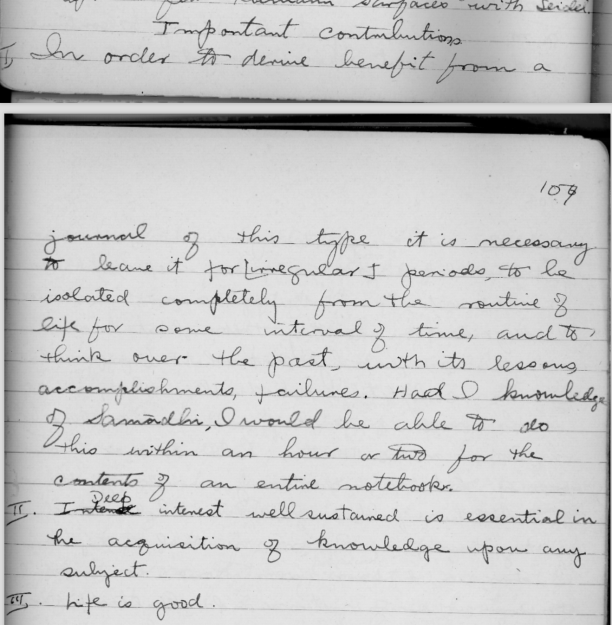
DDK maintained a charmingly frank notebook diary during his Harvard years. On the 19th of January 1927 he notes: A most restless day. I have forgotten to mention Monday the 17th and an important conference with Birkhoff thereon […] Problems: Fermat’s Last Theorem, the Four color map, the functional equation […] Today was unusually restless with a great deal of time spent, possibly wasted in the Widener. Looked up old issues of Outing, Shakespear’s Hindi Readers, most of Burton’s works [of him more later], Roosevelt on African and Brazilian ‘sporting’ – worthless – Stefansson’s excellent and much remembered ‘Friendly Arctic‘…
All this variety in a single day! To recall Wordsworth, Bliss indeed it was in that dawn to be alive! Kosambi, just out of his teens, was just bursting with energy, both intellectual and physical (for which one must read the diaries in some detail). The earnestness that only comes at that age shines through on the pages quite unselfconsciously:
Exuberance indeed, but also some simplicity: Deep interest, well sustained, is essential in the acquisition of knowledge upon any subject. And the third realization of the day: Life is good. Yes indeed, to be young was very heaven.
- D D Kosambi: Selected Works in Mathematics and Statistics is published by Springer. ISBN: 978-81-322-3676-4


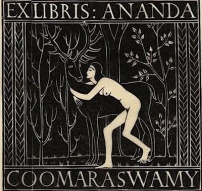 The amount paid suggests that the books were viewed as very valuable: Rs 75K in the late 1960’s was a huge sum of money. And given that, it was quite amazing that the collection had not been kept as one, but the books had apparently been shelved by subject (!) and were then like any other books, and so subject to the periodic culling that most libraries undertake to clear shelves and make space for new books. (In some sense I was not too surprised, having myself bought a book that had been owned by AnandaKentish Coomaraswamy and that had somehow made its way to Princeton. The initials AKC were pencilled in on the first page, but apart from the bookplate, there was little else to show that it had been his. Unfortunately that book is no longer with me, and in hindsight, I think that when libraries acquire collections from scholars of note, they should make some attempt to keep the collections intact. Mercifully the JNU has done that now with more recent acquisitions..).
 Nevertheless, a chance conversation shortly thereafter on the vagaries of libraries and the nature of intellectual inheritances started me off on my exploration of Kosambi and his mathematics. The idea was, on the face of, a simple one. What was the extent of Kosambi’s mathematical contributions compared to, say, his contributions to history or numismatics. How would the math stack up? Having been in TIFR before I came to JNU, I had also heard of how he travelled from Pune to Bombay every day on the Deccan Queen, how he was fired from TIFR, etc. etc. But I also found out that precious little was known of DDK’s other life by the historians. That the mathematics was too different and far too difficult is all too true, but still.
 To start with, I thought it would be good to put together his life mathematical, namely all his math and stats papers. Much of that was on the web, except that it was in bits and pieces, and all over the place. No single bibliography was accurate, and no matter where I looked, there were gaps. Many of the Indian journals where he published were not (and still are not) digitized. Some of the names that were given in the existing lists were incomplete or incorrect, many papers were missing. The Rendiconti della Reale Accademia Nazionale dei Lincei or the Sitzungsberichten der Preussische Akademie der Wissenschaften, Physikalisch-mathematische klassewere both uncommon journals that were impossible to locate anywhere in India, for instance. I went to the Ramanujan Institute in Chennai in late 2009, looking for copies of the Journal of the Indian Mathematical Society and Mathematics Student where DDK had published a lot of his work in the 1930’s and 1940’s. It’s too depressing to recount that visit… Nothing could be located, and I left empty-handed after a wasted morning.
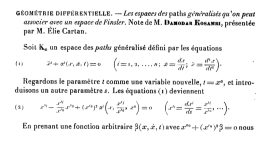 In 2010, though, I was visiting professor at the University of Tokyo for a month, and luckily, the Komaba campus where I was located, housed the mathematics department and more importantly, its library. It took a few hours spread out over several days, but before long, I not only had the bulk of DDK’s papers in photocopy or in digital form, but I also discovered, via MathSciNet, of DDK’s nom de plume S. Ducray, under which name he had written four papers. I also had access to the reviews of many of his mathematical papers by others, and could see many very famous names among the reviewers. As an aside, I should add that the library of Tokyo University is one of the few that have the complete sets of Journal of the Indian Mathematical Society and Mathematics Student, including the volumes published during the World War II years, when Japan and India were on different sides…